Maximizing Revenue per Click: CPC May Start the Funnel, but CPA Closes It
Learn how to combine CPC traffic with CPA offers to boost your affiliate earnings. Discover tech-focused strategies, EPC tactics, and top traffic sources.


Choose the paid event by checking what your audience is ready to do and what the offer actually counts. An install, a trial start and a purchase test different stages of the journey, even within the same vertical. Below: a matrix of the three events, the line between optimization signals and paid outcomes, and a filled-in event card to check with your account manager (AM) before you buy traffic.
A conversion event in CPA is the user action an offer pays for. CPI pays for a qualifying install, a trial offer for a qualifying trial start, and a purchase offer for a qualifying sale or subscription. The model label names the stage of the journey; the offer terms define which actions qualify.
Confirm the qualifying action before treating a model label as a complete event definition. Two offers with the same label can count different actions.
A CPI offer may pay only when the installed app is opened for the first time. A trial offer may count a trial start only after the user enters card details or meets another condition. A purchase offer may pay for a specific plan, a first payment or a sale that passes a refund window. None of these is standard; each offer sets its own.
Ask four questions before launch:
Keep the stages apart. A recorded conversion can still be rejected during confirmation, and a confirmed earning isn't money in your account until the payout.
Write the event definition in one sentence, in the offer's own terms, then build the campaign around it.
Assess the message, targeting and landing page together; the traffic format alone doesn't prove purchase intent. The same source can deliver users at different stages, depending on what the ad promises and where the click lands.
Three cases to tell apart:
These are starting guesses, not a fixed map of sources to events. CIPIAI's WPS Office popunder case shows the install end of the range: on cold popunder traffic in Vietnam in March 2026, the advertiser's own landing page beat every prelander variant the team tested. One campaign, not a benchmark, but the logic holds: cold users, one step.
Describe the intent you expect from your audience in one line, then pick the event that asks for that level of commitment.
Compare the action, friction and success measure for each event before reusing a campaign setup. The matrix below uses one fictional VPN product to show how the three paths differ.
Illustrative event paths for a fictional VPN product: not a claim that any real VPN offers all three models, and not current CIPIAI offer terms.
If the trial requires payment details and converts into a paid plan, the creative should not call the product free.
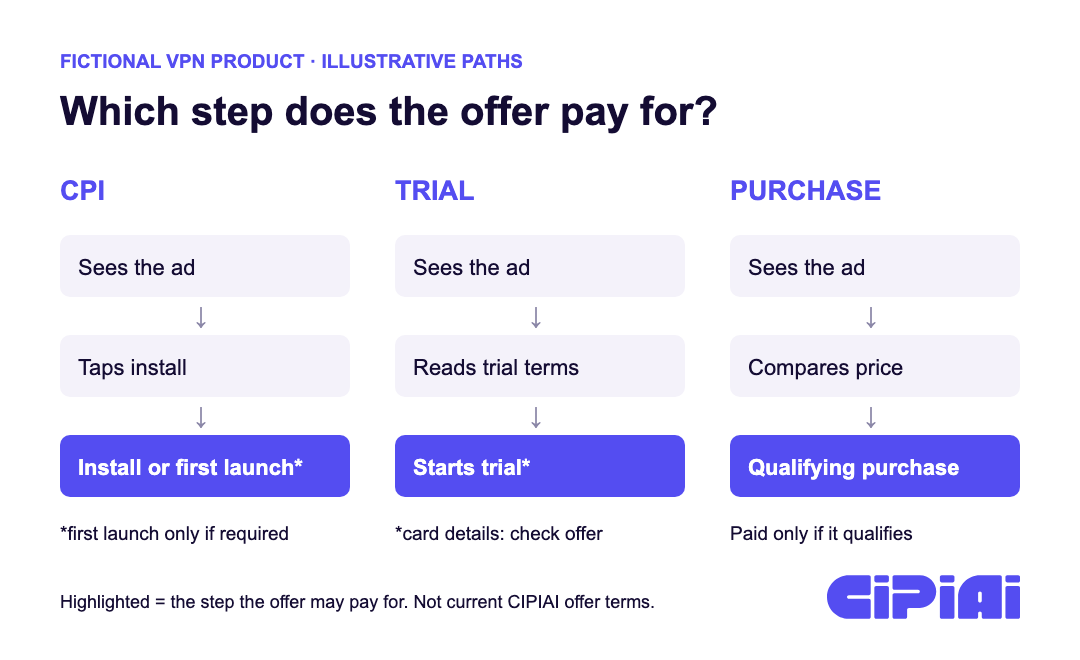
A VPN install and a VPN trial ask different things of the user, so a campaign built for installs can't move to a trial unchanged: confirm which action earns the commission, then point the creative's promise, the landing page and the measured event at that action. The CIPIAI guide to VPN offers on popunder and in-app traffic shows install-paid and trial-paid VPN offers side by side in its October 2026 catalog snapshot and explains why each OS should run as a separate campaign.
A signal used to optimize delivery is not automatically an event that earns a commission. Name both up front so your reports don't mix them.
In a RollerAds antivirus case published on August 30, 2024, the offer's original target action was listed as a $90 cost per sale. For testing, the team used checkout-page visits as the optimization event: a cheaper $1 action that let the test reach statistically meaningful results without spending the budget on sales. It's the network's own account of its bid model, so read it as a reason to name the two events separately, not as proof that checkout visits were paid or predict sales at a fixed rate.
An ad network may optimize toward installs or landing-page actions while the offer pays only for trials or purchases. Report the optimization signal as a diagnostic, and judge the campaign by the paid event.
Label every event in your tracker as "optimization" or "paid," and never add the two together.
More events at the top of the funnel don't mean more confirmed earnings, let alone a profitable test. Compare confirmed earnings per dollar of spend on the same event, after the same confirmation period.
Zumba's customer story on RevenueCat, published by the vendor, reports an 8% increase in install-to-paid conversion from A/B testing trial lengths, including shortening its trial from 14 to 7 days. The story doesn't say whether that is a relative change or percentage points, gives no baseline, sample size or test period, and comes from a fitness app, not a VPN. It isn't a rule to shorten every trial or a CPI-versus-trial experiment. Its lesson is narrow: the team judged a trial change against paid subscriptions, not trial starts alone.
Educational example: all figures below are fictional and are not CIPIAI benchmarks. Two tests each spend $200 on the same traffic. Test A records 400 installs; 300 are confirmed at $0.60, for $180 in earnings. Test B records 40 trials; 30 are confirmed at $7, for $210 in earnings. Test A produced ten times as many recorded events, yet Test B earned more. With different assumptions the result could reverse, which is why the comparison has to run on confirmed earnings.
Before you compare, ask your AM when each event usually reaches its final status. A trial or purchase may need longer than an install to confirm.
Map the user action to the report field, the commission rule and the next check.
Filled educational card: fictional offer, assumptions only.
Size the test with the guide to choosing your first CPA offer for your test budget, which covers volume and spending limits in detail.
If any field stays blank after you read the offer terms, hold the launch and ask your AM.
No. Check the offer: a trial can require payment details or other qualifying conditions. Describe those terms accurately in the creative.
No. Only installs that meet the offer's qualification rules count, such as a first launch, an eligible OS or a GEO in scope.
Treat it as a hypothesis based on audience, message and landing-page journey. The traffic format alone does not guarantee or rule out purchases.
Not without comparable event definitions, confirmed earnings and acquisition costs. A cheap event with a high CR can still earn less per dollar of spend.
Recheck it first. The creative's promise must prepare users for the new action and describe its terms accurately.
Tell your CIPIAI AM how users reach the offer and what they are ready to do. Discuss the qualifying event and the reporting available for your test. Register as a webmaster if you are new to CIPIAI.


Bisdev Solutions Limited
Room 701, 7/F, Lucky Centre, 165-171
Wanchai Road, Wan Chai, Hong Kong China
Copyright © 2026. Bisdev Solutions Limited
All rights reserved