What Are Survey CPA Offers: How They Work, What They Pay, and Where They Fit
Survey CPA offers pay affiliates for completed questionnaires — not purchases. Learn how they work, what they pay, and how to fit them into your traffic strategy.


Choose your first CPA offer by matching it to the traffic you can deliver, then checking what your test budget can buy. A higher payout is useful only if the required action and a meaningful test fit your audience and spending limit. Work through the checks below to prepare a test card for your CIPIAI account manager (AM) before buying traffic.
Write down the traffic you plan to buy, the action you want to test and the maximum amount you can spend. Include the source, format, audience GEO, device and OS so you can check each offer against the same setup.
An illustrative test question might read: “Can utility Offer A produce confirmed first launches from Source X push traffic on Android phones in Brazil within my fixed budget?” That question defines the event and traffic segment your test will assess.
Keep the test budget separate from your monthly buying budget. Record the amount you can spend on this particular check, including required extras, even if the campaign produces no confirmed earnings.
In RollerAds' November 2026 discussion, Renz Gonzales and Pierre Bertin recommend matching the offer to the source's audience and GEO, limiting the initial setup and tracking conversions before scaling. These are recommendations from network representatives, rather than an independent experiment. Their GEO-specific budget examples don't establish a minimum for your campaign.
An offer belongs on your shortlist only when its traffic rules, event and launch conditions match your setup. A high rate cannot compensate for a restriction your campaign will violate. Check the permitted source and format, audience GEO, device, OS versions and creative requirements. Confirm access for your account and enough available cap for the planned delivery. A catalog listing alone doesn't establish permission to start.
Then describe the paid event in plain language. Does an app offer require installation alone or installation followed by first launch? What purchase qualifies, and which users or actions are excluded? If the action is unavailable to your audience, remove the offer; if the definition remains unclear, ask your AM before spending.
Keep the stages separate. A recorded conversion may still await confirmation; a confirmed earning is also different from money received through a payout. Ask which report status represents each stage and when the available data can be reviewed.
Check the traffic source's funding requirements too. A deposit can exceed your intended campaign spend, so distinguish available cash from the amount you authorize the test to consume.
Separate required extra costs from the traffic budget, then calculate volume using the source's billing unit. Include new tracking, hosting, landing-page work or fees needed for this test; don't charge an existing tool to it again if there is no additional expense.
Educational example: every amount, rate and offer in the calculations and comparison below is fictional. These are not CIPIAI benchmarks or quotes.
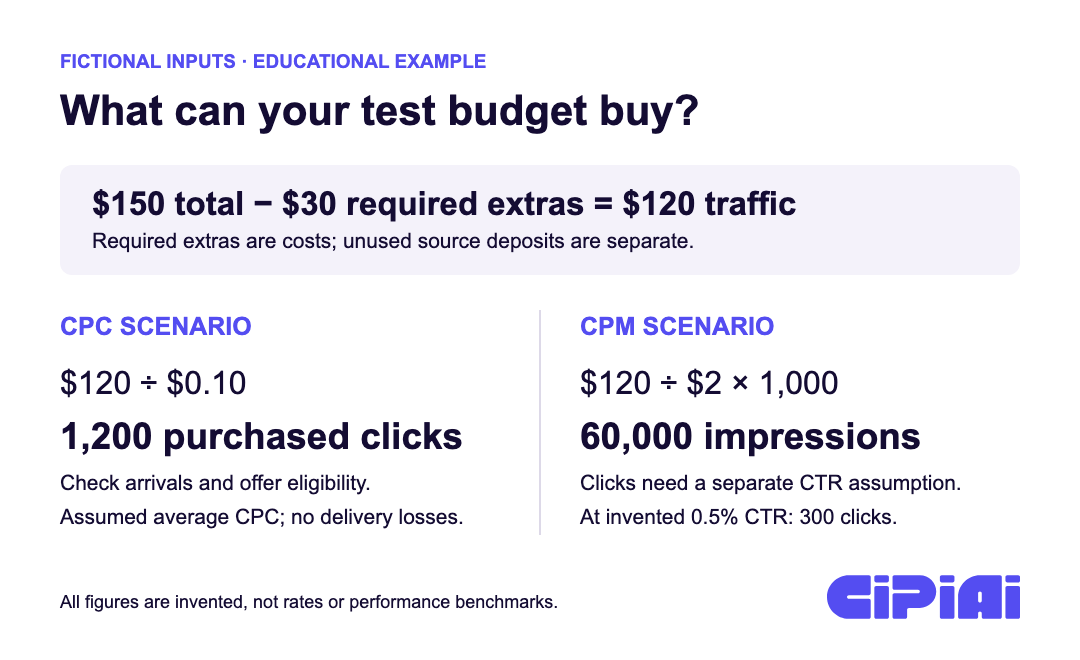
Suppose your total limit is $150, required extras cost $30, and $120 remains for traffic. Track unused deposits separately from actual spending while checking that your available cash covers both.
With CPC buying, estimate purchased clicks using the assumed average price:
Purchased clicks = traffic budget ÷ average CPC
$120 ÷ $0.10 = 1,200 clicks.
For the event calculations below, assume all purchased clicks reach the offer and meet its conditions. Routing losses, failed arrivals or mismatched traffic reduce the usable volume. Update the estimate if actual CPC changes.
With CPM buying, calculate impressions:
Impressions = traffic budget ÷ CPM × 1,000
$120 ÷ $2 × 1,000 = 60,000 impressions.
The CPM calculation estimates impressions. To estimate clicks, you need a separate CTR assumption:
Estimated clicks = impressions × assumed CTR
60,000 × 0.5% = 300 clicks.
The CTR is invented for this educational example. Without a defensible CTR scenario, stop at impressions; don't treat them as clicks or offer visits. Check whether your source charges for served or viewable impressions before applying its price.
Record both the estimated volume and its assumptions. Buying that volume doesn't guarantee a conclusive test.
A rare paid action can leave an affordable test inconclusive, even when the payout is attractive. Check what the action requires; the payout alone doesn't tell you how often it will happen.
The fictional offers below receive the same traffic. CR means confirmed paid events divided by eligible offer clicks. Both CR assumptions are arbitrary teaching inputs, with no campaign evidence behind them; they are not benchmarks for installs or purchases.
Neither scenario supports a profitable launch under these assumptions. Expected counts are model averages, not promised outcomes. A fractional expectation doesn't mean a campaign can produce part of a conversion.
Offer A might provide more observations if its assumed CR held, but that wouldn't establish better returns. If the budget cannot answer your question, narrow the test or postpone it. “Postpone both” remains a valid choice.
Published campaign illustration, separate from the educational model: An Adsterra partner case, published June 15, 2026, describes a US iOS VPN offer paying $1.60 per install, with approximately $332 spent during the reported campaign period. The page lists April 15–22 without an unambiguous campaign year. Those figures describe one campaign, not a minimum starting budget, a current offer quote or a CIPIAI result.
Use published cases to identify conditions worth checking. Your own traffic price, event and spending limit still determine whether the test is affordable.
Check how delivery is distributed across GEOs before sharing a cap across them. Separate or sequence segments when your budget cannot support parallel tests.
The CIPIAI traffic optimization team's October 2026 guidance recommends inspecting volume by GEO because a larger market can consume a shared limit. That leaves less traffic for the other countries, so an aggregate result may hide which audience the campaign actually tested.
Instead of asking whether an offer works everywhere, ask whether the defined event occurs on a specified traffic segment within your limit. Review the delivery forecast and the targeting controls available in your source. If one country is likely to absorb the spend, isolate it or test the remaining GEOs later under separate limits.
A narrow test makes its scope easier to interpret; it doesn't guarantee conversion or profitability. Record the GEO allocation before launch, including whether other segments are excluded, capped separately or queued for a later test.
Decide what you will check, when you will check it and where spending stops before you launch. The limit remains binding if the available data is inconclusive.
Use an early checkpoint to inspect targeting, arrivals and event transmission. At the hard limit, stop buying traffic, reconcile final charges and wait for the agreed reporting windows. Waiting for data doesn't require leaving the campaign running. Check how the source handles delivery or billing lag when enforcing its cap.
The CPA offer testing guide covers campaign execution in more detail. Keep this test's spending ceiling binding regardless of time-based guidance; choosing an offer doesn't require copying every operational setting from another campaign.
Completed educational test card: fictional Offer A. All amounts and checkpoints below are illustrative, not recommended thresholds.
Copy the card and replace the assumptions with your conditions. If a launch requirement remains unresolved, keep the test on hold; any further spending needs a separate budget decision.
No. It depends on traffic cost, the event and the scope of the test.
Compare compatibility and affordable test volume before payout. A higher rate doesn't establish better economics.
Only if each receives enough volume for your question. Otherwise, test them sequentially with separate limits.
Use clearly labeled scenarios, not a forecast presented as fact. Ask whether comparable evidence exists before adopting a working assumption.
Postpone when launch conditions remain unclear or the available budget cannot support the required check. Resolve the gap before buying traffic.
Before spending, ask your CIPIAI AM to confirm that the offer permits your planned campaign and to clarify the paid event and cap. Use those conditions to complete your test card. New to CIPIAI? Register as a webmaster.


Bisdev Solutions Limited
Room 701, 7/F, Lucky Centre, 165-171
Wanchai Road, Wan Chai, Hong Kong China
Copyright © 2026. Bisdev Solutions Limited
All rights reserved