VPN Traffic Sources in 2026: Push vs Pop vs Native
VPN traffic in 2026: how Push, Pop, and Native actually perform for VPN, cleaner, and iOS utility offers, plus a traffic source worth testing.



Every "best push ad networks" list you'll find was written by a company that sells push traffic. RichAds ranks RichAds first. PropellerAds ranks PropellerAds first. Both are honest about their own numbers and quietly vague about everyone else's, which is what you'd expect: they're competing for the same media buyer.
We're not. CIPIAI is a CPA network for tech verticals, so traffic sources sit above us in the chain, not across from us. Whichever network you buy from, we'd rather you buy well. That makes this comparison cheap for us to write honestly and expensive for a vendor to write at all.
A push ad network is a platform that sells advertisers access to a base of users who opted in to browser or device notifications, and delivers ads as notification-style messages to those users' screens. Payment is usually per click (CPC), sometimes per thousand impressions (CPM), and increasingly per conversion through target-CPA bidding. The format works because the ad arrives outside the browsing session, when nothing else is competing for attention; it fails when the subscriber base behind it is stale, bot-heavy, or resold three times over before it reaches you.
That last part is where the money goes, and it's what the comparison below tries to make visible.
Check the ad-format page of any network on a "push" list before you deposit. A sizeable share of them no longer sell classic push at all.
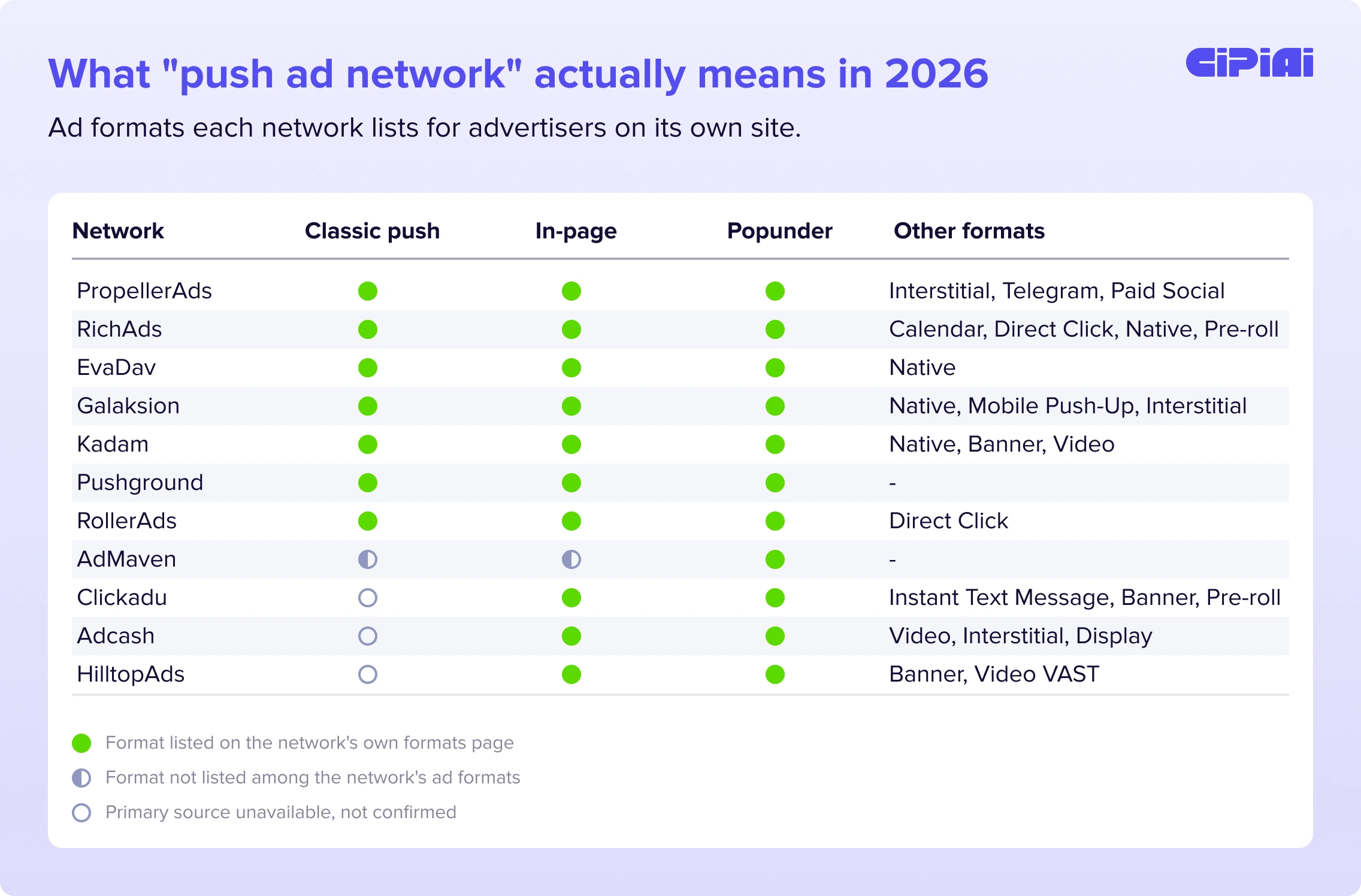
Adcash lists five advertiser formats as of August 2026: video, pop-under, in-page push, interstitial, display. No subscription push. HilltopAds lists popunder, in-page, banners and video VAST. No subscription push either. Clickadu sells InPage Push and something called Instant Text Message, a mobile dialog window; classic push isn't among its advertiser formats. All three sit on push listicles anyway, because "push" became a category label before it became two different products.
The distinction is not cosmetic:
RollerAds puts the reason plainly on its own homepage: in-page reaches macOS and iOS users "who don't see traditional push ads due to platform-specific restrictions." That's a vendor naming the ceiling on its own primary format, and it's the clearest one-line statement of why this split exists at all.
Is in-page push worse than classic push? Not worse, different. In-page gives you iOS and volume that subscription push physically can't reach; subscription push gives you a user who once clicked "Allow," which is a weak but real intent signal. Buying in-page while your bid model and creative logic assume subscription push is how campaigns quietly underperform for two weeks before anyone checks.
If you're mapping formats against each other more broadly, our traffic sources hub covers where push sits relative to pop, native and search.
Everything below comes from each network's own public pages, checked in August 2026, except where the source column says otherwise. Blanks mean we couldn't verify the figure from a primary source and chose not to invent one.
¹ Figure published by PropellerAds (April 2025) in its own competitor roundup, not confirmed on the network's site at time of writing. Treat as directional. ² Pushground doesn't publish a deposit floor on its own site, and secondary sources disagree with each other. Ask before you plan a budget around it.
Every network in this table sells push. That sounds like a low bar for a push comparison, and it turned out not to be: checking each one's own format page against its reputation is the first thing we did, and it's the first thing worth doing before you deposit anywhere.
Bought traffic from any of these and need somewhere to send the conversions? CIPIAI runs direct tech offers on push and pop: VPN, utilities, antivirus, browser extensions. Monetize push traffic with tech CPA offers →
Twelve years old and no longer a push network in any narrow sense; the platform now runs push, in-page, popunder, interstitial, Telegram and interactive formats off one account. Its own roundup puts daily audience at 15 million for push and 4 million for in-page across 195+ GEOs, with CPA Goal bidding and rule-based automation on top.
What that buys you in practice is a single account you can move budget around inside when a format dies on a GEO, without opening a new relationship and re-verifying. What it costs you is the usual multisource trade-off: fewer of those impressions are from publishers PropellerAds owns the relationship with end to end.
One thing worth knowing before you plan creatives around it: PropellerAds enforces creative policy harder than most of this list. Running a VPN smartlink through popunder in March 2026, we had an account paused for policy review because prelanders rotating inside the smartlink included scare-style security warnings. The same offer ran on AdMaven without incident. That's documented in full in our VPN smartlink case study, and it's not a complaint about PropellerAds; stricter moderation is part of why their inventory stays cleaner. It's a planning constraint, and it's the sort of thing no network will list on its own features page.
Who should start here? Buyers who want one platform for several formats, run creatives they control, and are willing to blacklist aggressively during the first week.
The most complete disclosure on a single page. RichAds publishes a $0.003 entry CPC and a $150 starting budget directly on its push page, claims 220+ GEOs and 5 billion daily impressions, and names its own strongest verticals as gambling and betting, finance, utilities and antivirus, dating, sweepstakes, nutra.
Two features matter more than the headline volume. Performance Mode restricts delivery to sources that already converted for similar campaigns, which shortens the blacklist grind. Target CPA lets you hand over bid management once you have enough conversion data to make that safe — and only then, because target-CPA bidding on thin data mostly buys you expensive noise.
RichAds also sells calendar push and Telegram ads, which are worth testing separately rather than folding into the same campaign structure.
Clickadu is the most transparent network here about what traffic costs before you register: its advertiser page shows live volume and CPC by GEO, device and format. In-page push on Android showed 43M daily impressions in India at $0.02 and 3M in the US at $0.07 when we checked in August 2026. Popunder on Android in Vietnam sat at 18.7M and $1.34 CPM.
Read those numbers as a rate card, not a promise. They tell you whether a GEO is worth planning around, which is more than most networks will show a stranger. Pricing models include SmartCPA, so conversion-based bidding is available once your postback is clean.
The format caveat from earlier applies: what Clickadu sells as push is in-page, plus a mobile dialog format. If your creative strategy depends on subscription push behaviour, this isn't the match.
Ten billion push impressions a month and 60 million active subscribers, per its advertiser page, across 250 GEOs. Instant advertiser approval and roughly two-minute creative moderation, which for anyone who has waited a day for a campaign review is a real operational difference rather than a marketing line.
The feature worth singling out is subscription-age targeting. Push subscriber bases decay: a user who allowed notifications eighteen months ago behaves nothing like one who allowed them last week, and most buyers never segment on it. Being able to buy fresh subscribers separately is one of the few genuine quality levers in the format.
Estonian, in-page and pop only, and unusually specific about fraud: Adcash states its anti-fraud technology saved advertisers $35.88M in 2024, with 300 million unique users daily and 200+ supply partners. Campaigns start from $100 or €100. VPN and software sit in its named top verticals, alongside sports, iGaming, adult, VOD, app installs and finance.
Adcash publishes a VPN campaign case study and a pin-submit case study, which is more vertical-specific evidence than most networks put in public.
The cheapest way into the format on this list: $50 minimum deposit, stated plainly on its own features page. Latvia-registered, operating since 2014, 1.5 billion daily impressions and 30,000+ partners. Formats cover popunder, native, on-page notification, push notification, mobile push-up and interstitial, and a CPA pricing model is available rather than CPC-only.
Fifty dollars won't get you a statistically meaningful test on a Tier-1 GEO. It will get you far enough to see whether the interface, the postback and the account manager work before you commit real budget, and that's a legitimate use of a low deposit floor.
The biggest published impression figure here: 273 billion a month across 250+ countries, drawn from 239,000+ traffic sources, with a $100 minimum deposit and eight payment methods including USDT. Its per-vertical daily volumes are broken out publicly: software at 250.4M impressions daily, pin-submit at 294.8M, finance at 775.3M.
HilltopAds sells in-page rather than subscription push, and is explicit that in-page suits VPN and dating offers. Auto Optimization blacklists unprofitable zones without manual work, which matters more on 239,000 sources than on 500.
Fourteen billion impressions a day, running since 2012, and the only network here that offers full campaign management at no extra cost: strategy, creatives, landing pages, optimization and scaling handled by their team, with self-service available as the alternative. Formats span popunder, push, banner, native, video and in-page push; pricing runs CPC, CPM and CPA Target.
Free management is not free. You're trading control and, usually, your creative angles for someone else's time. For a buyer entering a GEO they've never worked, that trade can be worth making for the first month. For anyone with a working funnel, it rarely is.
Self-service, push and popunder, with a $50 minimum deposit and around 2 billion daily impressions across 180+ GEOs per PropellerAds' roundup from April 2025. Toolset is thinner than the larger platforms; API access and reporting are there, deep automation isn't. We couldn't confirm current figures from AdMaven's own pages, so treat these as directional and check before you deposit.
Where AdMaven earned a specific note from us: in the same March 2026 VPN smartlink run that got paused on PropellerAds, AdMaven's moderation let the identical offer through and it kept delivering. Looser creative standards cut both ways, and which side you land on depends on whether you're the one running aggressive prelanders or the one bidding against someone who is.
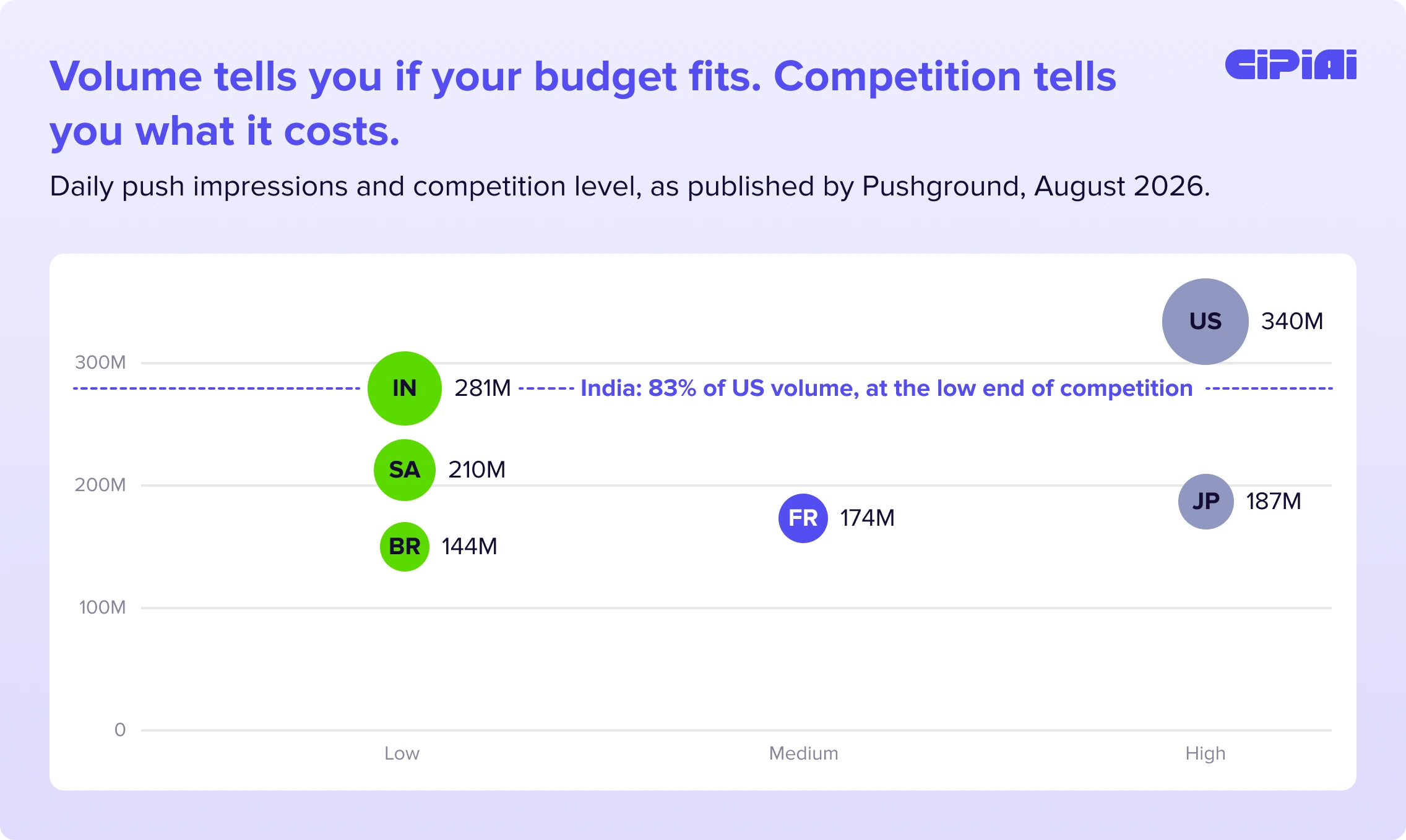
Barcelona-based, and the only network here that publishes how contested a GEO is alongside how much volume it has. Its push page shows daily impressions and a competition rating side by side: US at 340M impressions with high competition, India at 281M with low, Saudi Arabia at 210M with low, Japan at 187M with high. Volume tells you whether a GEO can absorb your budget. Competition tells you what you'll pay to get it, and almost nobody publishes the second number.
Entry CPC is $0.001, the lowest published figure on this list, against 200 million-plus subscribers. Formats run classic push, in-page and pop. Antivirus gets its own vertical landing page alongside adult and gambling, which is a useful signal if you're running security or utility offers: a network that built a page for the vertical has usually built supply for it too.
One gap worth naming. Pushground doesn't publish a minimum deposit anywhere on its own site, and the secondary sources quoting one don't agree with each other. Ask an account manager before you plan around a number you found in a roundup.
The clearest documentation of the eleven on the two things buyers ask about first. RollerAds states a $50 minimum deposit on its homepage, next to the pricing model per format: CPC for push, CPM for OnClick pop, plus a CPA Goal bid model. Scale claims are 7B+ daily impressions, 10M+ daily clicks, 20,000+ direct publishers and 60,000+ advertisers.
Subscription age sits in its published targeting list, which matters more than the position on that list suggests. It's one of two networks here that lets you segment on how recently a user opted in, and that single setting does more for push quality than most bid optimization.
RollerAds also explains the iOS problem in its own words rather than leaving buyers to discover it: in-page push, it says, reaches macOS and iOS users "who don't see traditional push ads due to platform-specific restrictions." A vendor being straight about the ceiling on its own primary format is worth noting, because most of this category isn't.
Any of these will happily sell you traffic. None of them will pay you for the conversions. If your tech-vertical campaigns need offers behind them, monetize push traffic with tech CPA offers →
Eight steps, in the order that saves the most money.
1. Ask an account manager for their top three GEOs before you register. Volume estimators are optimistic and reviews age badly; the GEO answer is checkable against your own results within a week. A network strong in Southeast Asia and a network strong in DACH are not competitors, and no listicle can tell you which one you're looking at.
2. Confirm which push you're buying. Classic subscription push and in-page push need different bids, different creatives and different expectations about iOS. Check the ad-formats page, not the blog.
3. Match the minimum deposit to your test plan, not your budget. A $50 floor is a cheap way to check the interface and the postback before you commit. It is not a test budget, and a network that asks for $150 isn't asking for a better one.
4. Verify postback before spending anything. A campaign that runs three days on broken tracking costs you the spend plus the conclusion you drew from it, and the second one is worse.
5. Check moderation strictness against your creatives before you build them. Networks differ sharply here, and the difference only surfaces after you've spent money. The same VPN smartlink that got our account paused on PropellerAds ran without issue on AdMaven. Ask what gets rejected, not what gets approved.
6. Ask whether subscription age is targetable. On classic push it's the single most useful quality control available, and most buyers never touch it.
7. Run one GEO and one vertical for the first week. Multi-GEO campaigns on a new source produce a blended number that hides which half worked.
8. Blacklist by zone from day two, not day seven. On networks with six figures of traffic sources, auto-optimization tools exist precisely because manual review doesn't scale; turn them on early.
How much budget do you need to test a push network properly? Enough for roughly 100 conversions at your target CPA on one GEO, which for most tech offers lands somewhere between $300 and $800. Below that you're reading noise, whatever the minimum deposit says.
Quality in this format decomposes into four things, and only one of them shows up in a network's marketing.
Subscriber freshness. A push base is a decaying asset. Users who allowed notifications a year ago have mostly stopped reacting, and a network with 200 million subscribers is not selling you 200 million responsive ones. Two networks here let you target on it directly: EvaDav and RollerAds both list subscription age among their targeting options. Where the setting exists, use it; where it doesn't, expect the average to drag your CTR down and price accordingly.
Source concentration. Traffic bought through RTB partners rather than owned publishers passes through more hands, and each hand takes margin and adds distance between you and the user. Networks that emphasise "direct traffic" (Galaksion) or "premium verified sources" (HilltopAds) are making a claim about that chain. Whether the claim holds is what your first blacklist tells you.
Bot filtering, stated in numbers. Adcash publishes a dollar figure for fraud blocked. Most networks publish an adjective. The dollar figure isn't proof, but a network willing to attach an audited-sounding number to its anti-fraud is at least accepting the question.
Creative fatigue speed. Push burns creatives faster than almost any other format because the same subscriber sees your ad repeatedly. RichAds recommends at least five creatives per campaign, which is a floor rather than a target. If your CTR halves in four days, that's fatigue, not a bad network.
Do push ads still work in 2026? Yes, and the market data supports the format's core advantage rather than the hype around it. In software and utility offers, push has out-converted popunder by close to 3x across the first half of 2026 in CIPIAI's own data, which matches the 2–4x spread the wider industry reports. The mechanism is straightforward: a push click is a click the user chose to make, and a popunder impression rides on attention nobody gave you. Popunder still wins on cost per thousand and on raw scale, which is why the two formats belong in the same media plan rather than in an argument. Our popunder guide covers that side.
The verticals push networks name themselves converge tightly. RichAds names gambling and betting, finance, utilities and antivirus, dating, sweepstakes, nutra. Adcash names sports, iGaming, adult, VPN/software, VOD, app installs, finance. Clickadu names paid content, social and entertainment apps, iGaming, tools and utilities, e-commerce, games, VPN. HilltopAds breaks out daily impression volume for software (250.4M) and pin-submit (294.8M) among others.
Utilities, VPN and antivirus show up on every one of those lists, and the reason is structural rather than fashionable: the offer is cheap, the value proposition fits in a notification headline, the conversion action is small, and the user doesn't need to be in a buying mood to take it. A notification saying your connection is exposed does work that a notification about a $400 purchase cannot.
That's also the part of the market CIPIAI sits in. If VPN is your vertical, the strategy side is covered separately in our guide to VPN CPA offers on push traffic, and the offer-supply side in best CPA networks for VPN affiliates.
Two campaigns worth reading before you plan yours: a VPN SmartLink run on popunder across US, BR and MX at 15–20% ROI, and a WPS Office popunder campaign in Vietnam at 30%. Both are pop rather than push, and both are useful here for the contrast: the GEO economics differ, the creative logic differs, the offer type doesn't.
Gambling and adult carry the largest volumes on push and the heaviest compliance load, with GEO restrictions that change without much warning. Nutra converts well and attracts the most aggressive creative practices in the industry, which is worth knowing before you compete on a zone against someone with looser standards than yours.
Which vertical should you test first on a new push network? Whichever one you already have a working funnel for. Testing an unfamiliar network and an unfamiliar vertical in the same campaign gives you a result you can't attribute to either.
A push ad network is a platform that sells advertisers access to users who opted in to browser or device notifications, delivering ads as notification-style messages. Advertisers typically pay per click, with CPM and target-CPA models available on most platforms. The network handles the publisher relationships, the subscriber base and the delivery; you bring the creative, the targeting and the offer.
Classic push requires the user to have subscribed to a publisher's notifications and appears on their device outside the browsing session. In-page push requires no subscription, appears inside a webpage styled as a notification, and works on iOS where subscription push effectively doesn't. In-page carries much larger volume and lower CPC; subscription push carries a weak opt-in signal that in-page has no equivalent for.
Entry CPC starts around $0.003 on Tier-3 GEOs, according to RichAds' published rates, and rises past $0.30 for premium markets. Clickadu's public rate card showed in-page push on Android at $0.02 in India and $0.07 in the US in August 2026. Price tracks GEO, device, format and competition on the zone, so treat any single figure as a starting point for planning rather than a quote.
It runs from $50 to $150 across the networks compared here. Galaksion, AdMaven and RollerAds sit at $50, Clickadu, Adcash, HilltopAds and EvaDav at around $100, and RichAds at $150 to start. Pushground doesn't publish a floor at all. The deposit tells you which buyer a network wants, not how good its traffic is: a $50 floor buys you a look at the interface, not a statistically meaningful test.
Not web subscription push in any meaningful volume. Safari on iOS only delivers web push to sites the user has added to their home screen as a web app, and almost nobody does that for a publisher site, so the subscriber pool an ad network can sell you on iOS stays tiny. In-page push does reach iOS normally, which is the main reason networks such as Clickadu, Adcash and HilltopAds built their notification-style inventory around in-page instead. If iOS sits in your media plan, you're buying in-page whether or not the network calls it push. App push notifications are a separate channel entirely and aren't what these networks sell.
They do, and the reason is the opt-in click rather than any property of the format itself. In software and utility offers, push has out-converted popunder by close to 3x through the first half of 2026 in CIPIAI's data, in line with the 2–4x range reported across the industry. The trade-off is volume: push subscriber bases cap out where popunder inventory doesn't.
At least five per campaign as a floor, which is what RichAds recommends, and more if you're running a base you've already touched. Push fatigues faster than most formats because the same subscriber sees your ad repeatedly, so a CTR that halves within a few days usually means creative burn rather than a quality problem with the source.
Every network compared here names software or utilities among its converting verticals, so the differentiator isn't the vertical, it's GEO overlap with your offer's payout map and whether subscription age is targetable. Adcash publishes a VPN-specific case study, HilltopAds breaks out software volume publicly at 250.4M daily impressions, and RichAds names utilities and antivirus in its own top four. Ask each account manager for their top three GEOs on the vertical and compare that against where your offer actually pays.
Push isn't a single product any more, and the lists that treat it as one are the reason buyers deposit into an in-page network expecting subscription behaviour. Check the format page. Ask for the top three GEOs. Verify the postback before the first dollar. Everything else is optimization, and optimization on a mismatched source is just a slower way to lose the test.
If you're buying push traffic for VPN, utilities, antivirus or browser extension offers, the traffic is the easy half. CIPIAI runs direct tech offers with weekly payouts and a $50 threshold, and account managers who work the same GEOs you're buying.
Monetize push traffic with tech CPA offers →
Network figures verified against each platform's own public pages in August 2026, except rows marked with a footnote. Rates, deposits and volumes change without notice; confirm with the network before committing budget. CIPIAI conversion comparisons are internal data, H1 2026, reported as relative ratios.


Bisdev Solutions Limited
Room 701, 7/F, Lucky Centre, 165-171
Wanchai Road, Wan Chai, Hong Kong China
Copyright © 2026. Bisdev Solutions Limited
All rights reserved