How to Promote VPN Offers in 2026
Looking to run VPN affiliate campaigns in 2026? Discover the best traffic sources, real GEOs, proven offers, and tips from insiders. CIPIAI helps you scale fast.


A traffic source is the channel you buy or earn attention from before sending it to an offer: an ad network selling push, popunder or native inventory, a platform like Telegram, Reddit or YouTube, or an asset you own such as an SEO article, an email list, or a browser extension. In CPA marketing the source isn't a preference, it's half the economics. The same VPN offer that returns 15–20% ROI on popunder across the US, Brazil and Mexico will behave completely differently on a channel where nobody arrived looking for a VPN, because the cost per thousand impressions, the intent behind the click, and the compliance risk change with every channel.
Four questions settle the choice:
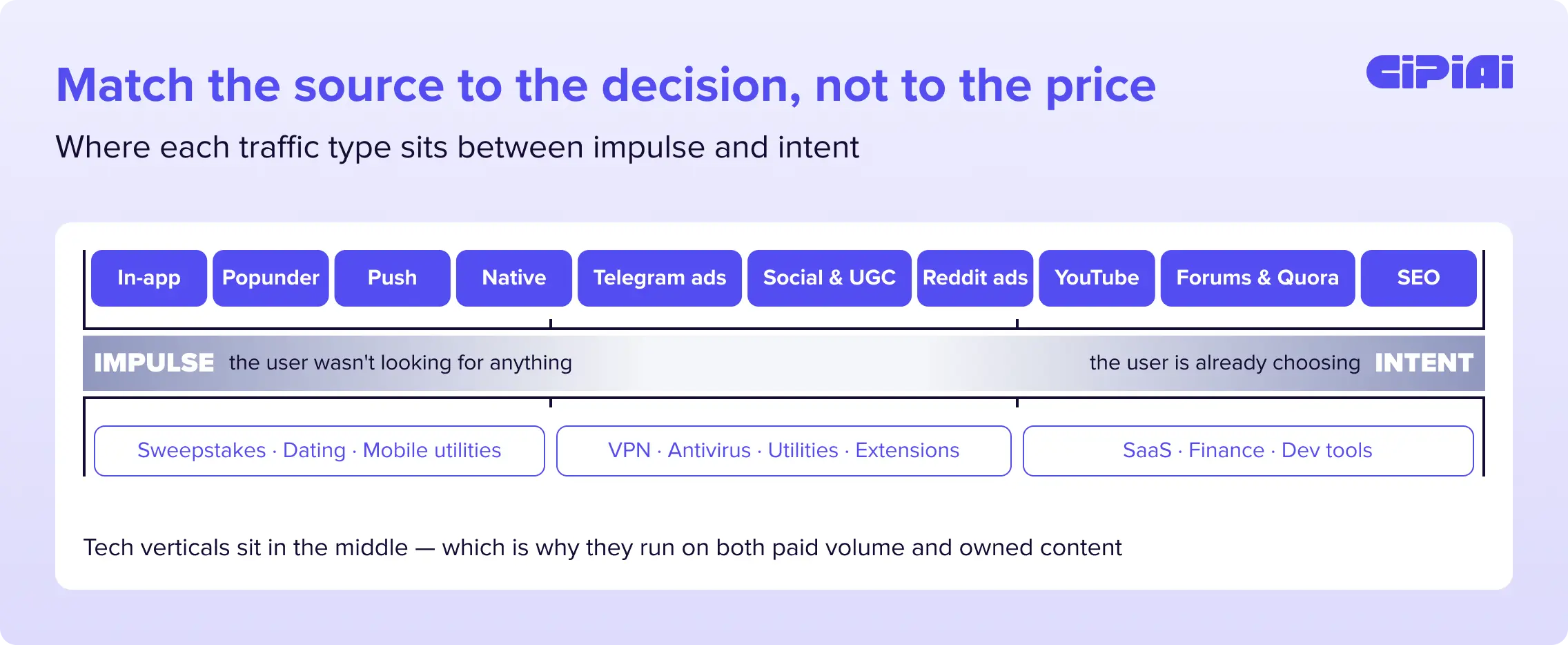
1. What does the vertical need? Impulse volume (push, pop, in-app) or considered intent (SEO, Reddit, YouTube).
2. What payout model are you on? CPA pays for volume; RevShare and hybrid pay for retention, which changes what a good source looks like.
3. What's the test budget? Paid channels need roughly $50–100 a day before the data means anything. Free channels cost months instead of dollars.
4. Which GEO does the offer actually pay for? Tier-1 is expensive and strictly policed; Tier-2 and Tier-3 are cheap and noisy.
The table below maps every major source to the verticals it works for, with a deeper guide behind each one.
Not sure which vertical to run at all? Start with Most Profitable CPA Niches in 2026, ranked by EPC and traffic cost.
Three shifts matter more than the rest of the noise.
Search got harder and more valuable at once. Google keeps rewarding pages that answer a question completely and keeps demoting thin content, which means an affiliate article now takes longer to rank and lasts longer once it does. AI answers sit on top of a growing share of queries, so a page that only restates the obvious gets summarised away, while a page with a real comparison table gets cited.
Paid inventory stopped being uniformly cheap. Push CPMs have climbed since the format's low-cost era, and the networks that still sell genuinely cheap volume are usually selling in-page push rather than classic browser push, which behaves differently and converts differently. Anyone comparing 2024 push prices to 2026 push prices is comparing two different products.
Platform enforcement tightened on social. Meta and TikTok review ad accounts harder than they used to, and affiliate accounts sit near the top of the risk list, which pushed a lot of media buyers toward channels where the account isn't the asset at risk: pop, push, Telegram, and owned assets.
Push works because the user opted in once, and it stays cheap because the inventory keeps regenerating. A campaign reads within days rather than weeks; you can run a $50 test on one GEO and know whether the offer has a pulse.
The trap is treating all push as one format. Classic browser push goes to people who consciously subscribed to a site's notifications, and in-page push is a banner styled to look like a notification, served to anyone. Both get sold as "push traffic" at very different prices, so ask which one you're actually buying before comparing CPCs across networks.
Our own numbers point where the industry points. Inside the software vertical, push converted at 1.51% against popunder's 0.53% over the same period, roughly a 2.85x gap. Push costs more per click and returns more per click, which is what opt-in attention does against interruption.
Eleven networks compared on deposit, GEO, format and pricing: Best Push Ad Networks in 2026.
Popunder is the volume workhorse, and for a lot of media buyers it's the only channel that scales without a proportional increase in creative work. There's no creative to fatigue, since the offer page itself is the creative. Our pop-under guide puts eCPM between $0.50 and $5.00 depending on GEO and traffic quality, with viewability at 100% by definition.
Two of our published case studies show the range: a VPN SmartLink run on popunder across the US, Brazil and Mexico returned 15–20% ROI, and a WPS Office campaign in Vietnam returned 30%. Neither came from clever creative; both came from matching a low-friction offer to cheap, high-volume attention in a GEO where the payout still made sense.
The cost of that volume is quality variance. Pop inventory carries more bot traffic and more accidental clicks than any other paid format, so a pre-lander that filters intent and a network that filters fraud matter more here than anywhere else.
Android-heavy Tier-2 and Tier-3 traffic, sold through SDKs inside free apps. It's cheap, it's enormous, and it converts well for install offers, cleaners and mobile utilities where the user's next action is a tap rather than a form.
One rule decides whether in-app pays: match the format to the action you're asking for. A tap that ends in an install fits a user who is mid-game; a form, a card entry or a subscription flow does not, and no amount of volume fixes that mismatch. Cap the test tightly, judge it on conversion rate rather than click count, and stop early if those two numbers move in different directions.
Format-by-format breakdown: Mobile App CPA Offers for Pop and In-App Traffic.
Native buys attention inside editorial context, which raises quality and raises cost at the same time. It suits health, crypto and utility offers where the user needs a paragraph of persuasion before clicking, and it punishes affiliates who point native traffic straight at a raw offer page.
Budget for content production, because native without a decent advertorial is just expensive display. Expect a longer read on results too: native needs more spend before the data settles than push or pop, which makes it a poor first channel and a reasonable second one.
The slowest channel and the only one that keeps working after you stop paying. An article that ranks for a commercial query produces registrations for months without further media cost, which is why SEO fits RevShare and hybrid deals with high lifetime value: SaaS, VPN, finance.
The honest timeline is three to six months of consistent publishing before a new site produces anything, longer if the niche is crowded. What shortened in 2026 is the payoff for depth: a single thorough comparison page can hold hundreds of long-tail keywords, while ten thin posts hold almost none. If you're going to write, write one page that answers everything rather than ten that answer fragments.
Trust at a scale nothing else matches, because a face reading a script for four minutes does what no banner does. VPN, adblockers, finance and eCom all convert on review and tutorial formats, and a single video keeps converting for months after upload.
The cost is production and patience. You need a channel with some history before the algorithm distributes anything, and affiliate links in descriptions convert far worse than links mentioned in the video and repeated on screen.
The highest-intent free traffic available, and the fastest to get you banned if you treat it as a placement. People go to r/VPN or a webmaster forum already deciding between products; a genuinely useful comment inside that decision outperforms almost any ad.
Paid Reddit is a separate and underrated option: our Reddit ads guide puts CPMs between $0.50 and $4.00, well under Meta, with the caveat that Reddit users detect and punish polished commercial creative. Community-native copy outperforms studio creative by a wide margin.
Narrow, cheap, and still underpriced compared with the mainstream platforms. Telegram works for VPN, antivirus and productivity offers, with the strongest results in Eastern Europe, MENA and Southeast Asia. Our Telegram guide documents a campaign at roughly 97% ROI where the targeting matched the channel's actual subject matter.
Two paths exist and they behave differently: official Sponsored Messages, capped at 160 characters of text with an optional button, and direct buys inside channels, which are unregulated, negotiable, and only as good as the channel owner's honesty about their audience.
Fast reach, mobile-first, and the most compliance-sensitive channel on this list. Sweepstakes, eCom and EdTech offers convert on TikTok and Instagram when the creative looks like something a user made rather than something a brand bought.
Account health is the real constraint here, and a banned account costs more than a weak creative ever will, which is why the warm-up routine deserves more attention than the creative pipeline: TikTok Account Warm-Up for Affiliates.
Not a source of new attention, a way of getting more value out of attention you already paid for. Email suits nutra, SaaS and education offers with a natural second purchase, and retargeting recovers the fraction of paid traffic that bounced without converting.
Deliverability is the whole game, so authentication and list hygiene decide whether any of this works. A list bought from a third party will burn a sending domain faster than it produces a single conversion.
Attention that never produces a tracked click: AI answers, in-app ecosystems, browser extensions with affiliate logic built in. Attribution moves from the click to the event, which breaks a lot of traditional affiliate setups and rewards anyone who owns the surface where the decision happens.
This is the most technical entry on the list and the one with the longest build time, but an installed extension is an asset no auction can price you out of. Full argument: Zero-Click Traffic Monetization.
Free traffic isn't free; you pay in months instead of dollars, and the invoice arrives later. Paid traffic reverses the trade: instant volume, instant feedback, and the budget disappears whether or not the offer converted. Affiliates who last usually run both, because the two fail in completely different ways.
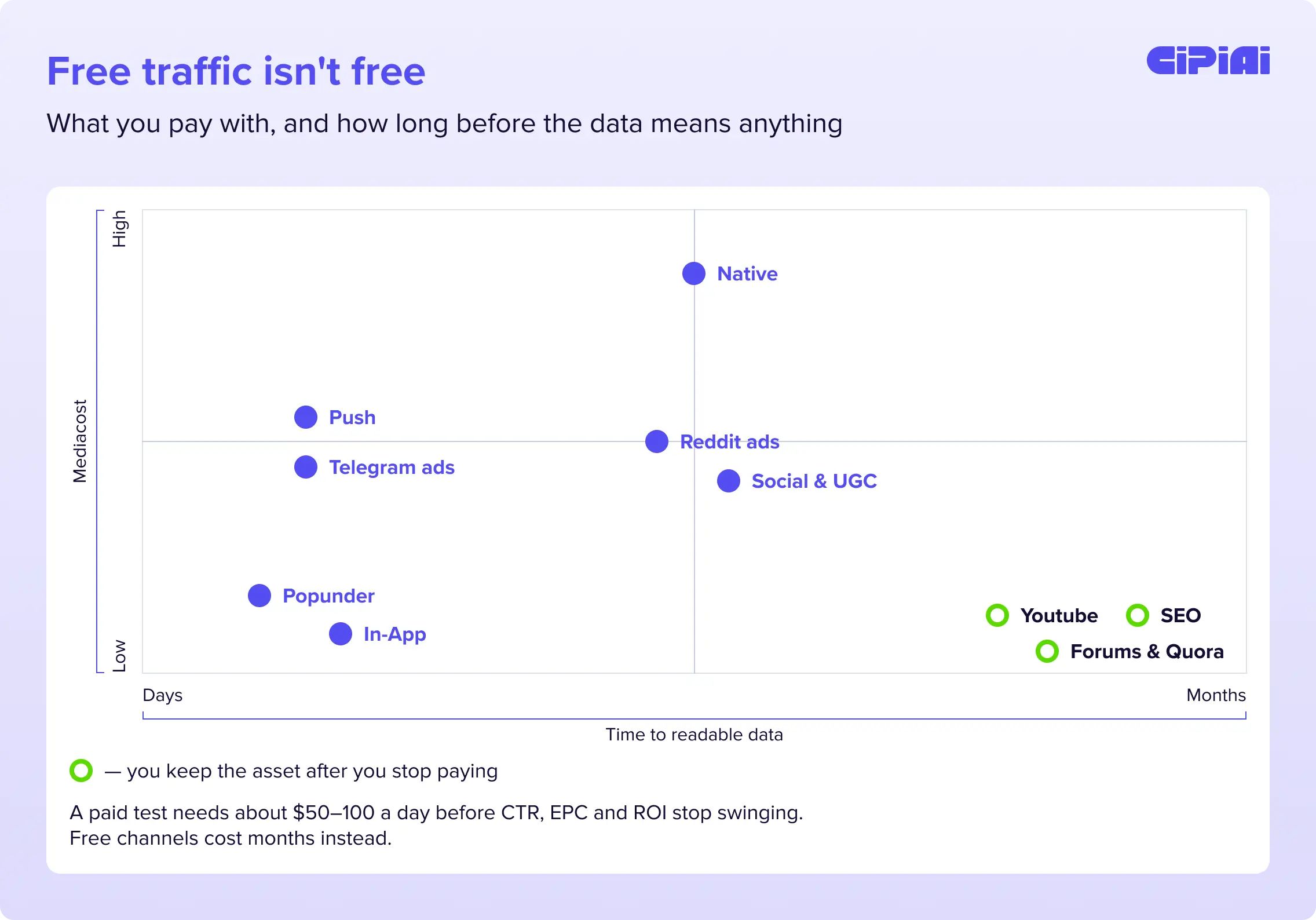
Free sources that still work in 2026. SEO content, which starts slowest and compounds hardest. YouTube and Shorts, where one review keeps converting long after upload. Reddit, Quora and niche forums, where intent is high and bans are fast. A Telegram channel you own, which is the closest thing to an owned audience most affiliates ever build.
What free traffic actually costs. A ranking article takes three to six months and steady publishing before it produces registrations. A useful presence in a subreddit takes weeks of participation before a single link survives moderation. If you need to know this week whether an offer converts, free traffic can't tell you; a $50–100 a day paid test can.
Choosing between them. Testing a new offer is a paid job, usually push or pop, because you need readable data in days. Scaling something proven is also paid, with wider GEO and format coverage. Building an asset you keep is free traffic's job: SEO, video, owned channels. A vertical with a long decision cycle wants free traffic at the top with paid retargeting underneath.
The sequencing most people get backwards: use paid traffic to find out which offers convert, then build free assets around the winners. Doing it the other way round means spending six months ranking for an offer that was never going to pay, which happens more often than anyone admits publicly.
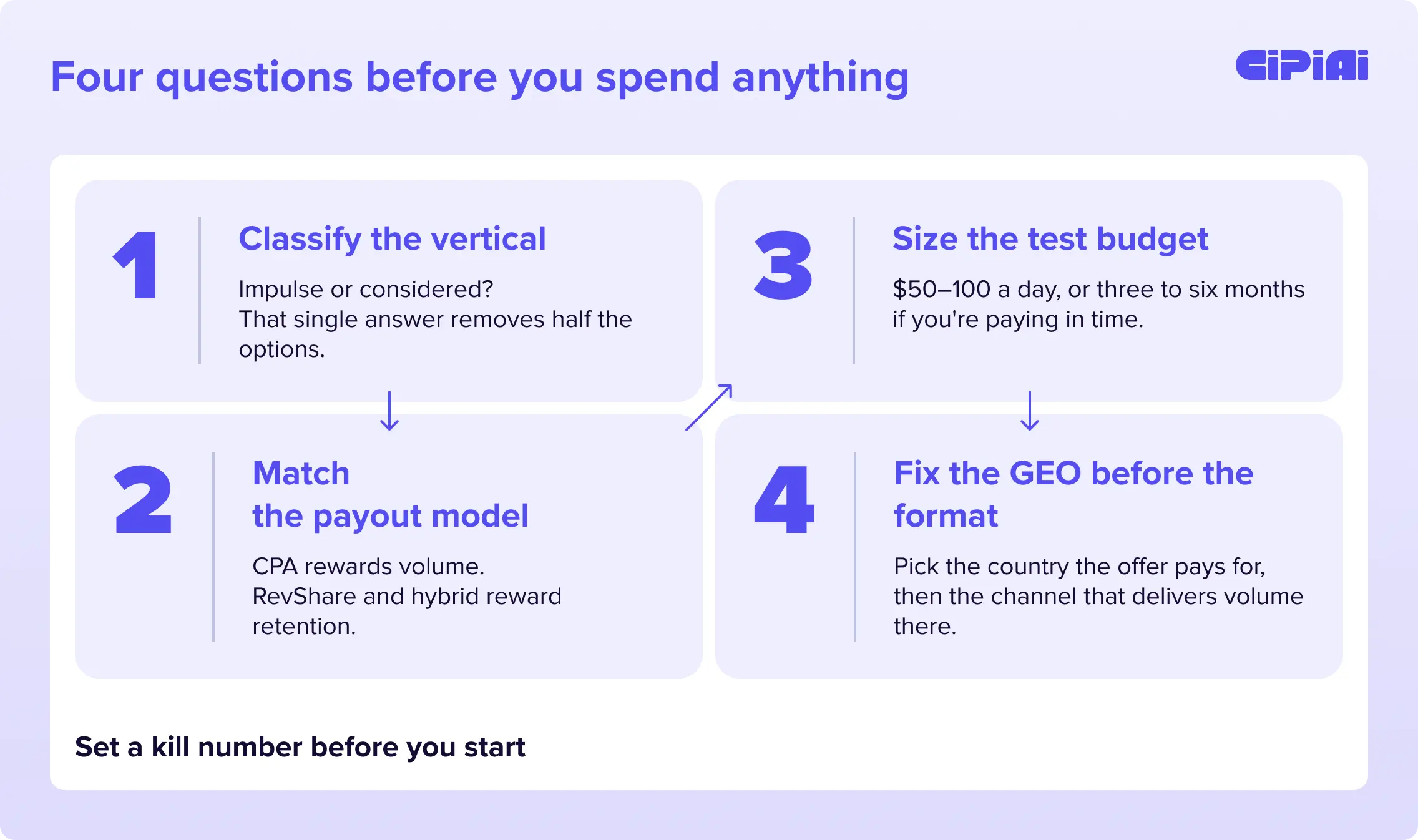
Fix the GEO before the format. Check what the offer actually pays in each country, then pick the channel that delivers volume there. Choosing a format first and hunting for a GEO afterwards is how test budgets vanish.
Give the test enough money to be readable. Under roughly $50 a day, you're collecting noise and calling it data. Run one offer, one GEO, one format, and let it accumulate enough clicks that the conversion rate stops swinging.
Watch conversion rate, not click volume. Cheap clicks are the easiest thing in this industry to buy and the least meaningful. A campaign can look healthy on click count for a full week while producing nothing anyone would pay for.
Change one variable at a time. New GEO or new format, never both. Two changes at once produce a result you can't attribute to anything.
Set a kill number before you start. Decide what spend without a conversion means the test is dead, write it down, and honour it. Affiliates rarely lose money on a fast no; they lose it on a slow maybe.
Two things we can show from inside the network rather than repeat from someone else's blog.
Push beats pop on conversion rate in software offers by a wide margin: 1.51% against 0.53% over the same window, a gap of roughly 2.85x. Popunder still carries more absolute volume, which is why both formats keep earning their place in the mix.
Popunder pays when the offer is low-friction and the GEO is priced sensibly, with our published case studies landing at 15–20% ROI for a VPN SmartLink across the US, Brazil and Mexico, and 30% for WPS Office in Vietnam.
Paid sources: push, popunder, in-app, native, Telegram ads, Reddit ads and social platforms. Free sources: SEO content, YouTube, forums and communities, plus owned channels like email or a Telegram channel. Paid buys speed and data; free builds an asset you keep. Most profitable affiliates run a mix.
Match the source to how the buying decision gets made. Impulse verticals such as sweepstakes, dating and mobile utilities work on push and pop, where volume is cheap and intent is low. Considered verticals such as SaaS, VPN and finance need SEO, YouTube or forums, where the user is already looking for a solution. Running a considered vertical on impulse traffic is the most common way to burn a test budget.
Push and popunder have the lowest entry cost among paid channels and produce readable data within days. Free sources cost nothing in media but need months before they produce volume. With a small budget and no audience, start with a paid push test on a single GEO and reinvest whatever works.
Popunder and push carry most of the volume, with native and Telegram ads working for higher-intent Tier-1 audiences. Two of our campaigns show the range: a VPN SmartLink on popunder across the US, Brazil and Mexico returned 15–20% ROI, and a WPS Office popunder campaign in Vietnam returned 30%.
There's no single answer, and anyone selling you one is selling their own inventory. Push and pop work for dating, sweepstakes and utilities; SEO and YouTube suit tech offers like VPNs and SaaS. The right source depends on your niche, budget and offer type.
Push ads, TikTok and social media are the easiest to launch and test, with quick feedback and low entry costs. SEO also works for anyone willing to invest in content over months rather than days.
Yes, particularly for RevShare and hybrid offers. It costs more time upfront than any paid channel and returns traffic that doesn't stop when the budget does.
Around $50–100 a day on paid traffic, enough to gather meaningful data on CTR, EPC and ROI. Scale what converts and stop what doesn't.
No. Some affiliates use automation or cloaking, but the results that scale and survive come from white-hat methods, especially in tech and regulated verticals. Quality traffic beats tricks.
CIPIAI runs tech, VPN, utility and extension offers across push, pop, native and search traffic, with the payout model and GEO shown on every offer card.


Bisdev Solutions Limited
Room 701, 7/F, Lucky Centre, 165-171
Wanchai Road, Wan Chai, Hong Kong China
Copyright © 2026. Bisdev Solutions Limited
All rights reserved