Best CPA Networks for VPN Affiliates in 2026: Ranked & Compared
Looking for the best CPA network for VPN offers? We ranked the top 5 networks by payouts, GEOs, and support quality — so you don't waste budget finding out the hard way.


Last updated: October 2026
The best niches for affiliate marketing in 2026 are VPN, utilities, browser extensions and software, each matched to the traffic type that can reach its payout: VPN and utilities for popunder and push, extensions for in-app, and software and SaaS trials for SEO and email audiences. Traffic type decides the fit more than the vertical does, so adding a profitable niche usually means pointing a source you already run at an offer with the payout model that source already carries.
Most "best niches" roundups rank verticals by a payout screenshot someone posted in a chat, then leave the reader to guess whether their own traffic can reach that number. This guide works from the other direction: start from the traffic type you already run, and see which niches its payout model and volume profile already qualify you for. It covers VPN, utilities, extensions and software, matched against popunder, push, in-app and paid social traffic, because those pairings carry over without rebuilding a campaign from zero.
In 2026, the best niches for affiliate marketing are the ones whose payout model your existing traffic can reach. For traffic bought by the click (popunder, push, in-app, most paid social), that means VPN, utilities and extensions running CPI or single-step CPA: the action confirms fast, and the payout is priced against cheap inventory. For traffic you can reach again (SEO, email, a subscribed audience), software and SaaS programs running a recurring revenue share fit better, because their value builds over months rather than on the first click.
Four pairings cover most of the fit:
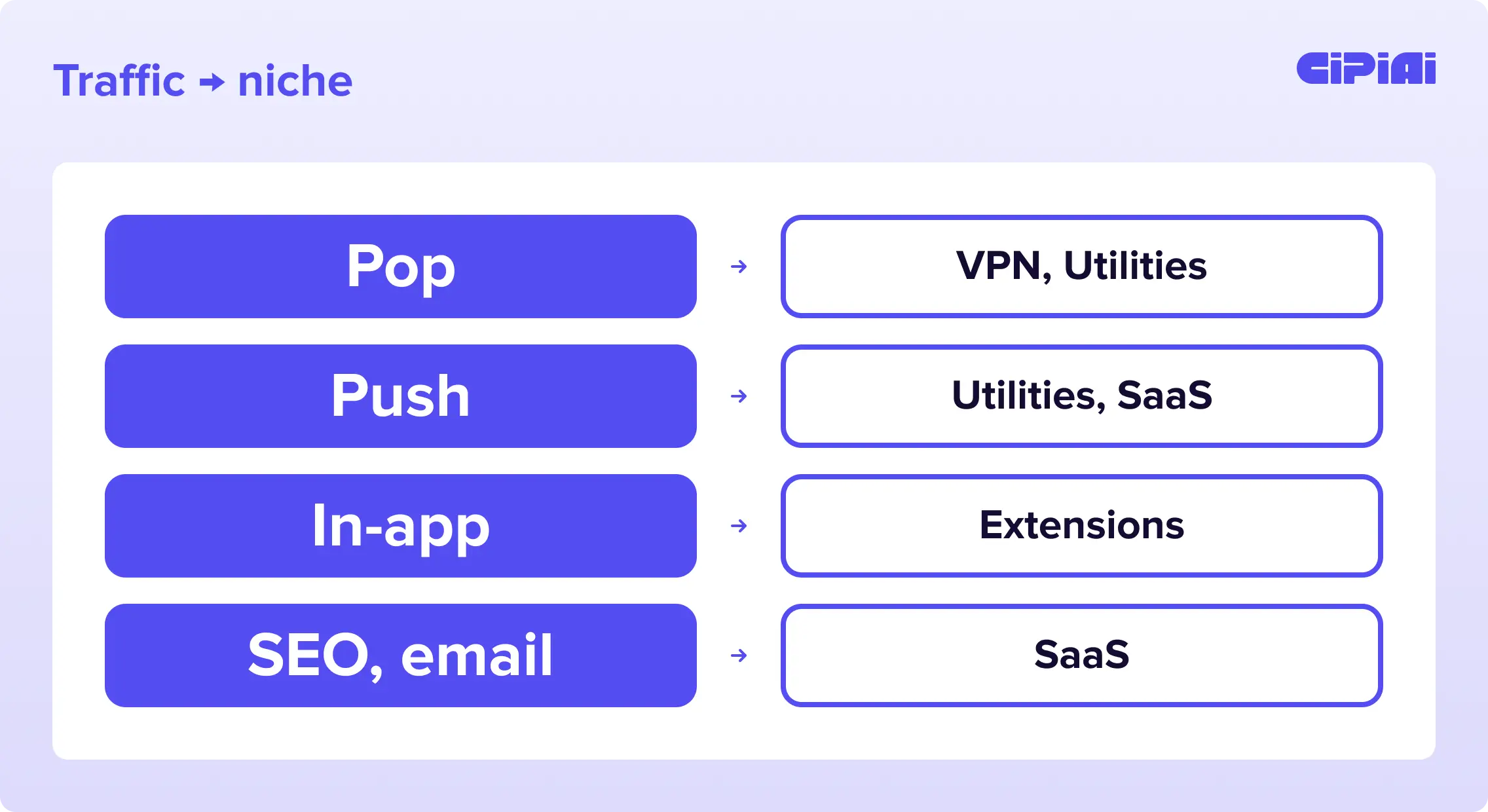
Takeaway: a niche is "best" relative to a traffic type. The next section turns that into a working match.
Choose the niche by the traffic type you already run: that is your real specialization, and it transfers to a new vertical inside the same payout model. A popunder source built for volume, a push source built for creative-testing speed, or an in-app source built for install flows each moves cleanly to a new vertical, while the vertical itself is the part that changes fastest as offers open and close.
The practical filter has two questions, in order:
1, Is your traffic paid for once, or can you reach it again? Bought volume (popunder, push, in-app, most paid social) fits install and single-action payouts. A returning audience (SEO, email, a subscribed list) is the only kind of traffic that makes a recurring revenue share worth running.
2. What payable event does the niche require, and how many steps sit between your click and that event? An install-only payout confirms on the first step. A SaaS trial confirms three steps later (signup, trial activation, first charge), and the traffic cost is paid up front regardless of where the funnel stops.
One route cuts across all four rows rather than sitting inside one: moving the same traffic type from a Tier-1 GEO to Tier-2, inside the same vertical. It's covered as its own route below, because the traffic type doesn't change; only the GEO, the bid and the volume do.
Takeaway: match the payment event before comparing payout numbers. Two offers with the same headline payout can require a completely different number of steps between your click and the money.
If you haven't matched your traffic to a vertical at all yet, start with traffic sources compared by vertical, payout model and cost. This section assumes you already have a working traffic type and want the niche side of the match. Each route below follows the same structure: what's already working, what carries over unchanged, what changes, and the first step to test it.
What's already working: popunder traffic already delivers volume against a VPN install or activation payout.
What carries over: - The traffic source and the volume approach that already clears a VPN CPI or CPA threshold. - The preland structure and click-quality filtering built around that source. - The general approval and review flow for running install-based offers.
What changes: - The offer itself moves from a VPN payout to a utility payout: cleaners, optimisers and ad blockers (more on utility offers) run the same CPI logic on a different product. - GEO priority, since utility demand doesn't skew the same way by GEO that VPN demand does.
First step: pull the utility offers open on popunder in the same tier your VPN traffic already runs, and test at the volume you'd normally allocate to trialling a new VPN offer, rather than a separate, larger budget. Our guide to testing a CPA offer covers caps and the 48-hour read.
What's already working: push traffic already delivers volume against a utility CPI payout.
What carries over: - The traffic source and delivery mechanics. - Creative-testing cadence: push notification copy and icon testing transfer almost directly between a utility offer and a software trial. - General targeting muscle for OS and device segments.
What changes: - Funnel length: a SaaS trial pays on a confirmed signup or first charge, not on install, so the payable event sits several steps further down the funnel than a one-click utility action. - Creative angle: a utility promises an immediate fix, while a SaaS trial has to earn a signup before it earns anything else.
First step: pick one software or SaaS trial offer that pays on trial start rather than first charge, and run it on the same push placements as the utility offer, at a fraction of the usual test budget until the funnel length proves out.
What's already working: in-app traffic already delivers installs against a mobile CPI or CPA payout.
What carries over: - The traffic source and the in-app placement itself. - Ad formats: in-app creative units transfer close to unchanged. - The approval and review process for in-app placements generally.
What changes: - Device and browser requirements: an extension payout only fires on the specific browser-and-OS combination the store listing supports, which is narrower than most mobile in-app targeting by default. - The install action itself, which points to a browser store listing rather than an app store.
First step: confirm which browser-and-OS combinations the extension offer actually pays on before the first placement, then route a slice of the same in-app inventory to it at test volume.
What's already working: whatever traffic type you already run qualifies you for the same vertical in Tier-2 GEOs, with no source change required.
What carries over: - The vertical and offer type stay identical. - The traffic type and delivery mechanics stay identical. - The creative angle usually doesn't need to change by GEO tier.
What changes: - Bid and volume: Tier-2 clicks cost less and convert at a different rate, so both the test budget and the payout expectation move. - GEO-specific compliance and localisation: some Tier-2 markets carry their own advertising and privacy rules worth checking before the first spend.
First step: take the offer you already run on Tier-1 and duplicate the campaign into two or three Tier-2 GEOs at a fraction of the usual budget, before touching the creative at all.
The four niches below sit inside CIPIAI's own catalog, where the traffic-source logic above applies directly.
VPN carries the widest range of payout models in the catalog: an install-based payout for a Tier-1 volume source, and a confirmed-subscription payout for a source that can be re-targeted, both inside the same product. Traffic that fits: popunder, push and paid social on the install side; SEO and review content on the subscription side.
Utilities (cleaners, optimisers, ad blockers and other one-click browser or device tools) sit at the volume end of the catalog: the action is one step deep, and the payout is priced against cheap inventory rather than intent. It's the niche popunder and push traffic reach first, and the one a VPN-only operator already qualifies for without picking up a new source.
Extensions pay on the install itself, which makes this one of the few niches where a mobile in-app source and a desktop popunder source can run the same payout model side by side. Device and browser targeting decides whether the campaign works more than creative does. An extension offer promoted to the wrong OS burns the click before it has a chance to convert.
Software and SaaS trials move the payout model in the opposite direction: from a one-time action to a share of a subscription that has to survive its first billing cycle. A recurring share needs an audience worth re-engaging, which is why this niche pays off on SEO, email and community traffic more than on a single bought click. For the fuller comparison of payout families across the software catalog, see software affiliate programs compared by payout model and traffic type.
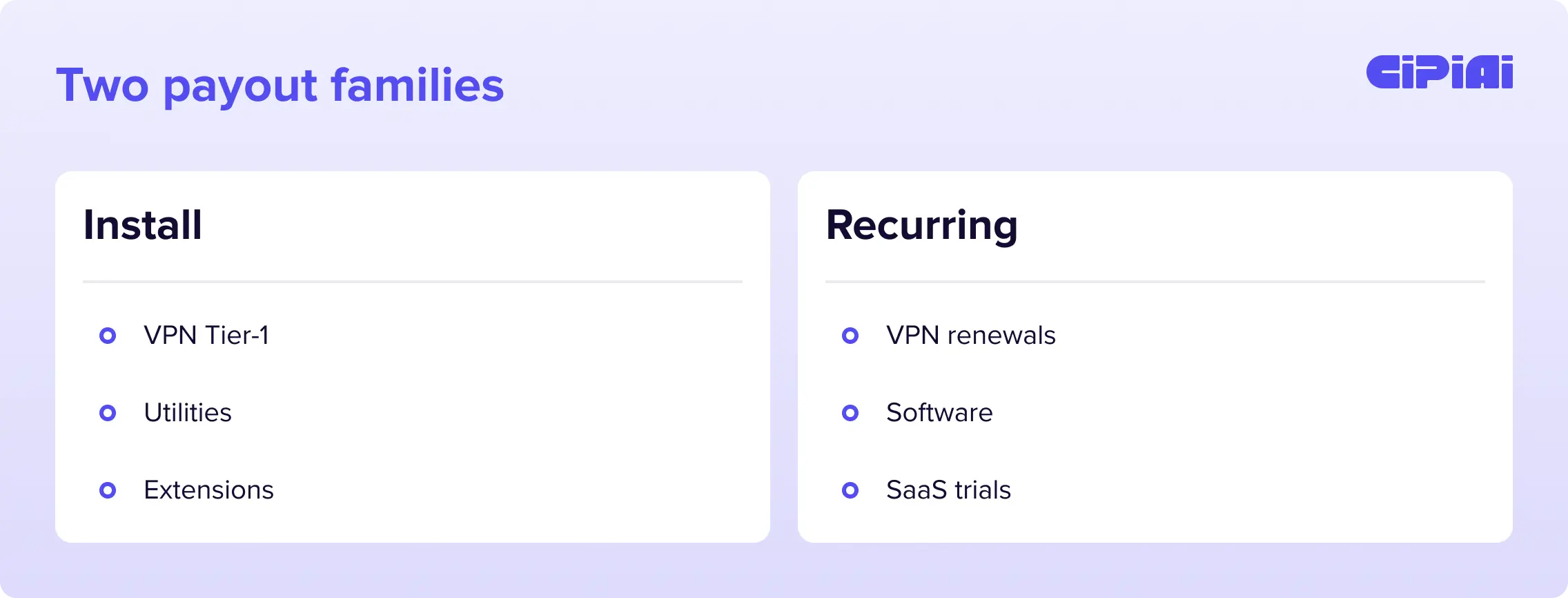
Takeaway: the four niches split cleanly into two payout families: install-based (VPN's Tier-1 side, utilities, extensions) and subscription-based (VPN's retention side, software). The traffic type you run decides which family is worth testing first.
Switching niches is a bad idea when the new niche's payable event, device list or GEO list sits outside what your traffic can reach, even if the payout model matches.
Funnel length is the most common mismatch. A source built for a single-step install struggles on a niche that pays only after a multi-day trial converts to a paid plan: the same clicks, measured against a payout event three steps further down the funnel, return a fraction of the modelled EPC on the first test. Confirm the payable event before switching, not after the first week's numbers come in.
Device and browser requirements cut volume quietly. An in-app source built for one mobile OS doesn't carry over to an extension niche gated to a specific desktop browser without a real drop in payable traffic. The drop shows up as a lower approval rate rather than an obvious error, so check the target device list before the first test.
GEO-payable lists don't always match a source's GEO reach. Moving a traffic type from Tier-1 to Tier-2 changes payout and volume, but only inside the GEOs the receiving niche actually pays on. Clicks outside that list are cost with no return, on any traffic type.
Takeaway: a route is worth testing once the new niche's payable event and payable GEO list are confirmed in advance. Working them out from the first week's results costs a full test cycle for nothing.
The highest advertised payouts sit in subscription-based niches: software and SaaS offers paid on a confirmed subscription rather than an install, because the payout reflects recurring revenue instead of a single action. Profitability in practice depends less on which niche has the highest number and more on whether your traffic type can actually reach that payout event: a source built for bought volume converts a multi-step subscription offer at a fraction of its advertised rate.
Start from the traffic source you already have access to, not the niche with the best reputation. Confirm whether that source delivers one-time clicks or an audience you can reach again, then match it to a payout model (install or single-action offers for bought volume, subscription share for a source with return visits) before comparing specific programs inside that category.
Yes, within the traffic types the payout model actually supports. A popunder source that converts on a VPN CPI offer typically qualifies for utility offers running the same payout model, and the same logic applies across push, in-app and paid social: the traffic type is the transferable asset.
Push traffic carries volume against install-based and single-action payouts: utilities, browser tools and mobile VPN are the standard fit. Software and SaaS trials that pay on a confirmed signup rather than install also work on push, provided the funnel length is priced into the test budget from the start.
Popunder fits the same volume-first niches as push (VPN on the install side, utilities and browser tools), because the traffic is bought by the click rather than filtered by intent. Subscription-share niches are a weaker fit for popunder unless the specific offer pays on a first action rather than on ongoing retention.
Already running one traffic source in one vertical? The same source usually qualifies you for two or three neighbouring ones. CIPIAI runs VPN, utilities, extensions and software offers across 200+ GEOs. Payouts run NET30 with autopayments, from $50 via payment providers and from $500 by wire transfer. Register as a webmaster →


Bisdev Solutions Limited
Room 701, 7/F, Lucky Centre, 165-171
Wanchai Road, Wan Chai, Hong Kong China
Copyright © 2026. Bisdev Solutions Limited
All rights reserved