A smartlink is a single affiliate link that routes each click to the offer most likely to convert, based on the user's GEO, device, and behavior. The rotation re-weights itself as performance data comes in, so revenue per click (EPC) gets optimized continuously, not once at campaign setup. No manual offer picking, no separate links per GEO.
This guide breaks down smartlink affiliate marketing from the inside: what happens between a click and the redirect, how auto-rotation decides which offer wins, and the setups where smartlinks beat direct offers, mainly mixed traffic and global GEO spreads. Where they're the wrong tool (tight funnels on one tested source), a direct offer still wins, and the guide says so.
You'll also see two working examples from CIPIAI: the Easy Flow mainstream smartlink and a VPN smartlink, with the traffic types each one absorbs.
Why Smartlinks Are Growing in Affiliate Marketing
Affiliate traffic is no longer predictable.
A few years ago, you could send traffic to a single offer and get stable results. Today, that approach breaks down. Traffic is fragmented across channels, devices, and GEOs — and each segment behaves differently.
mobile vs desktop
Tier 1 vs Tier 3 GEO
push vs search vs social
👉 The same traffic can produce completely different results depending on how it’s monetized.
""
Traffic Fragmentation
Modern affiliates don’t operate on one source anymore.
They combine:
SEO content
paid ads
push and pop traffic
social and in-app channels
Each source brings users with different intent and conversion behavior.
👉 Sending all of them to a single offer creates inefficiency:
low conversion rates
missed GEO opportunities
under-optimized EPC
Global Traffic Complexity
Affiliate campaigns are increasingly global.
Users come from:
different countries
different devices
different network conditions
And most importantly:
different monetization potential
An offer that works in LATAM may fail in Europe.
A mobile flow may outperform desktop.
👉 Manual optimization at this level becomes nearly impossible to scale.
The Need for Automation
This is where traditional affiliate setups start to break.
Manually:
selecting offers
testing GEOs
optimizing flows
…works at small scale — but not when traffic grows.
Advanced affiliates need systems that:
adapt in real time
route traffic automatically
maximize revenue per click
Where Smartlinks Fit
This is exactly the problem smartlinks solve.
A smartlink affiliate system automatically routes each user to the most relevant offer based on:
GEO
device
behavior
Instead of guessing which offer to use, the system optimizes distribution dynamically.
👉 Result:
higher EPC
better traffic utilization
scalable monetization
Why Advanced Affiliates Use Smartlinks
Smartlinks are not a beginner shortcut — they are a scaling tool.
They allow affiliates to:
monetize mixed or unknown traffic
test multiple offers simultaneously
eliminate manual optimization bottlenecks
👉 In other words:
Smartlinks turn fragmented traffic into a structured revenue stream.
And in a market where traffic is global, inconsistent, and constantly changing — that shift is exactly why smartlink affiliate marketing continues to grow.
What Is a Smartlink in Affiliate Marketing
A smartlink is an auto-rotating affiliate link that automatically redirects users to the most relevant offer based on real-time data.
Instead of sending all traffic to a single landing page, a smartlink acts as a distribution system — matching each user with the offer most likely to convert.
Definition
Smartlink affiliate marketing is a model where a single link dynamically routes users to different offers based on predefined rules and performance data.
How Smartlinks Redirect Users
When a user clicks a smartlink, the system instantly analyzes key parameters:
Based on this data, the smartlink selects the most suitable offer from a pool and redirects the user accordingly.
Why This Matters
In traditional affiliate setups:
one link = one offer
performance depends entirely on that choice
With smartlinks:
one link = multiple offers
performance is continuously optimized
👉 This shift turns a static setup into a dynamic monetization system.
Simple Example
A user from Brazil on an Android device clicks your link.
Instead of landing on a generic offer, the smartlink:
detects GEO (Brazil)
detects device (Android)
matches with the highest-performing mobile offer in that region
👉 Result: higher chance of conversion without manual optimization.
Key Takeaway
Smartlinks remove the need to manually choose the “best” offer.
Instead, they:
automate offer selection
adapt to traffic conditions
optimize revenue per click (EPC) in real time
Which is exactly why smartlink affiliate marketing is widely used for scaling global and mixed traffic.
How Smartlinks Work (Step-by-Step)
From the outside, a smartlink looks simple: one link, one click, one redirect.
Under the hood, though, it works like a routing engine.
The whole point of a smartlink is not just to redirect traffic — it is to distribute traffic intelligently so that each click has a better chance of generating revenue.
Step 1 — The User Clicks
Everything starts with a click.
This traffic can come from:
SEO content
paid ads
push notifications
social media
in-app placements
At this stage, the system does not assume that all users should see the same offer. That would defeat the purpose.
Step 2 — The System Analyzes the Traffic
As soon as the click happens, the smartlink evaluates the incoming user based on available signals.
Typical inputs include:
GEO
device type and OS
traffic source
historical conversion patterns
This is the decision layer.
Instead of sending every user to one destination, the system tries to identify which offer is most relevant for that specific click.
Step 3 — The Best Offer Is Selected
Once the traffic is analyzed, the smartlink chooses an offer from its rotation pool.
This is where auto-rotation logic comes in.
A smartlink does not rotate offers randomly. It rotates them based on rules and performance data, such as:
which offers convert best in a given GEO
which landing pages perform better on mobile vs desktop
which traffic sources generate stronger EPC with specific verticals
In other words, the system is constantly trying to match:
user profile → best-performing offer
Step 4 — The User Lands on the Offer
After selection, the user is redirected to the chosen offer or funnel.
From the affiliate’s perspective, this is the monetization moment:
no manual offer switching
no need to build separate links for every GEO
no need to guess which campaign will convert best
The smartlink handles that logic automatically.
Step 5 — Conversion Happens
If the user completes the target action — install, registration, subscription, purchase, or another defined event — the affiliate earns a commission.
The important part is that smartlinks are designed to improve not just conversion rate, but revenue efficiency.
That’s why EPC optimization sits at the center of smartlink systems.
A strong smartlink setup is not simply trying to maximize clicks or raw conversions. It is trying to maximize the earnings per click generated across mixed traffic.
Why EPC Optimization Matters
This is what separates smartlinks from basic redirect tools.
If one offer converts well but pays poorly, and another converts slightly less often but produces better EPC, a smartlink can favor the second one.
That means optimization happens at the revenue level, not just the conversion level.
👉 More clicks routed intelligently
👉 Better traffic utilization
👉 Higher monetization efficiency over time
Key Takeaway
The smartlink process is simple on the surface:
user clicks → system analyzes traffic → best offer is selected → conversion happens
But the real value comes from what happens in between:
automated routing
performance-based rotation
EPC-driven optimization
That is why smartlinks work so well for affiliates managing global, fragmented, or unpredictable traffic streams.
How Smartlinks Work in Practice (CIPIAI Example)
Up to this point, smartlinks may sound theoretical — a system that “automatically optimizes traffic.”
In practice, the difference becomes obvious when you look at a real implementation.
This is where networks like CIPIAI come in.
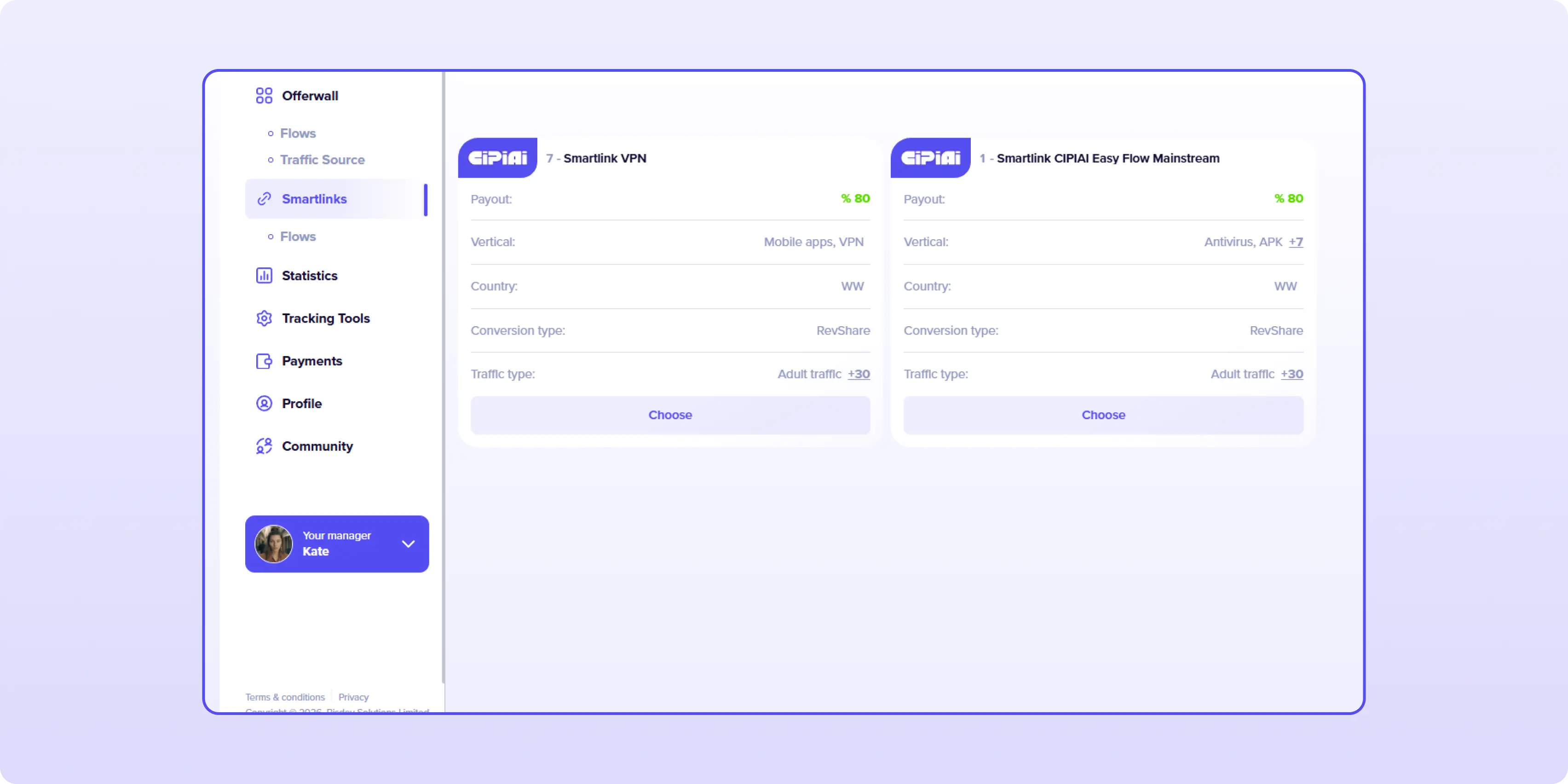
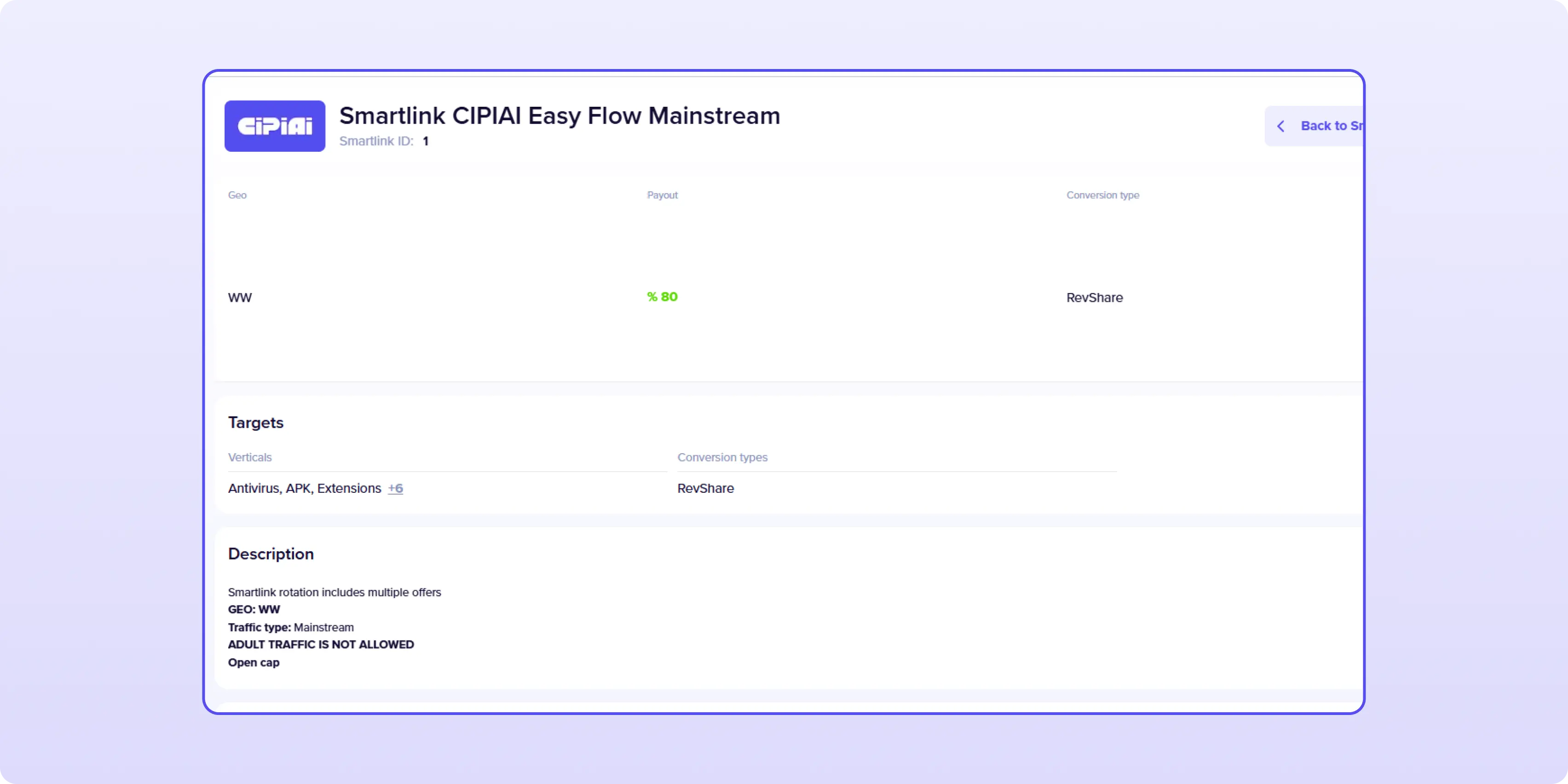
CIPIAI Smartlink: Easy Flow Mainstream
CIPIAI smartlinks are built around a simple idea:
👉 one link → multiple monetization paths
Instead of choosing a single offer, affiliates send traffic into a pre-configured smartlink, which automatically distributes users across different verticals and offers.
Key parameters:
GEO: Worldwide
Revenue model: RevShare up to 80%
Supported verticals:
mobile apps
PIN submit
surveys
utilities
VPN
How It Works in Practice
When a user clicks a CIPIAI smartlink, the system:
analyzes the traffic (GEO, device, source)
selects from a pool of relevant offers
redirects the user to the best-performing option
The important part:
👉 the smartlink rotates multiple offers automatically
There is:
no need to manually test dozens of offers
no need to build separate funnels for each GEO
no need to constantly switch campaigns
Everything happens within a single link.
Why This Matters
In a traditional setup, affiliates face a constant decision:
which offer to run
which GEO to target
which vertical performs best
With CIPIAI smartlinks, this layer is abstracted.
Instead of optimizing manually, you:
send traffic
track EPC
scale what works
Practical Advantage
This type of setup is especially effective when working with:
mixed GEO traffic
mobile-first audiences
multiple traffic sources
👉 because the system adapts automatically, rather than forcing you to predefine everything.
Key Takeaway
CIPIAI smartlinks turn the concept of smartlink affiliate marketing into a working monetization system:
automated offer rotation
multi-vertical coverage
global scalability
All handled through a single entry point — your smartlink.
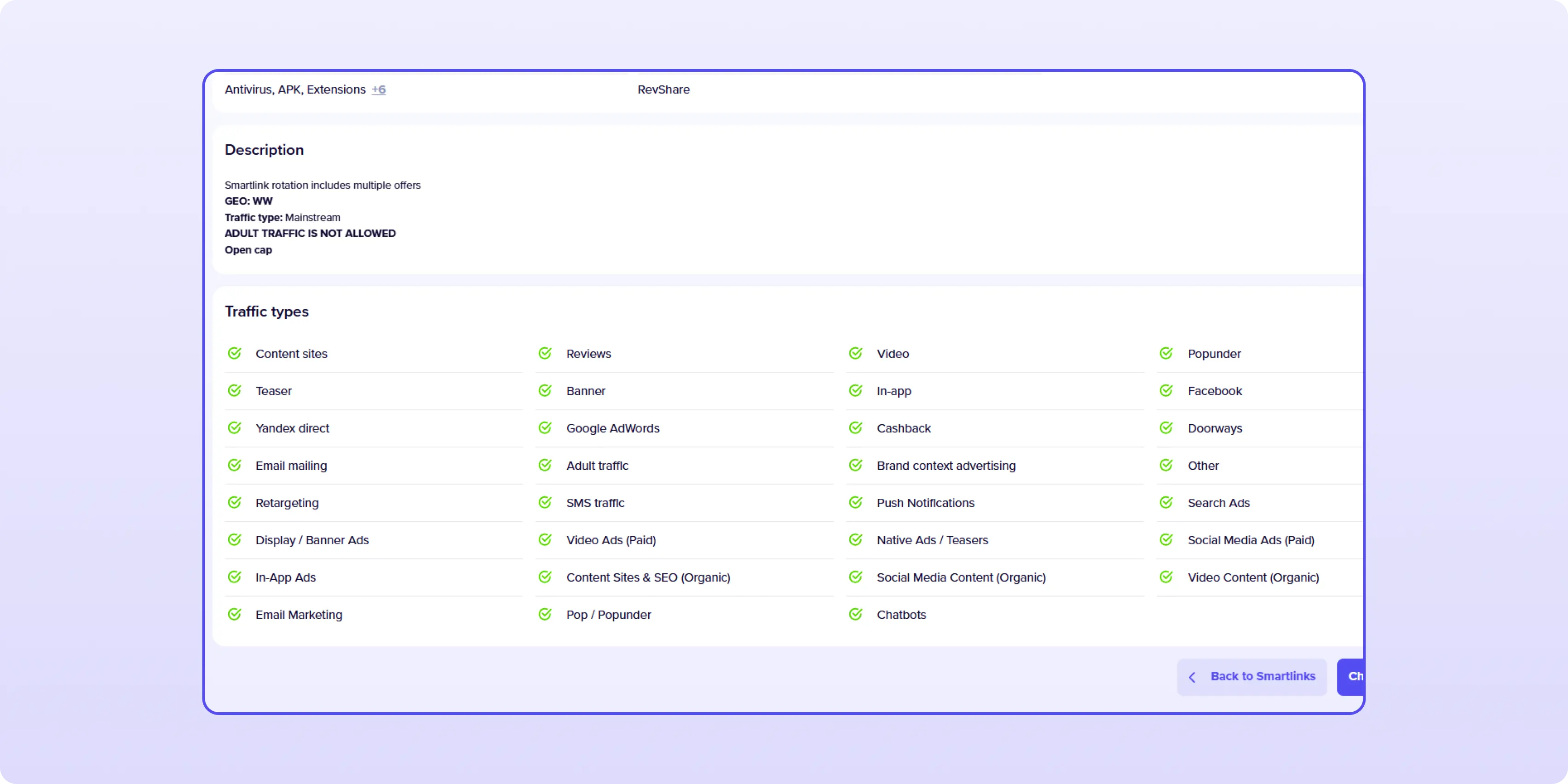
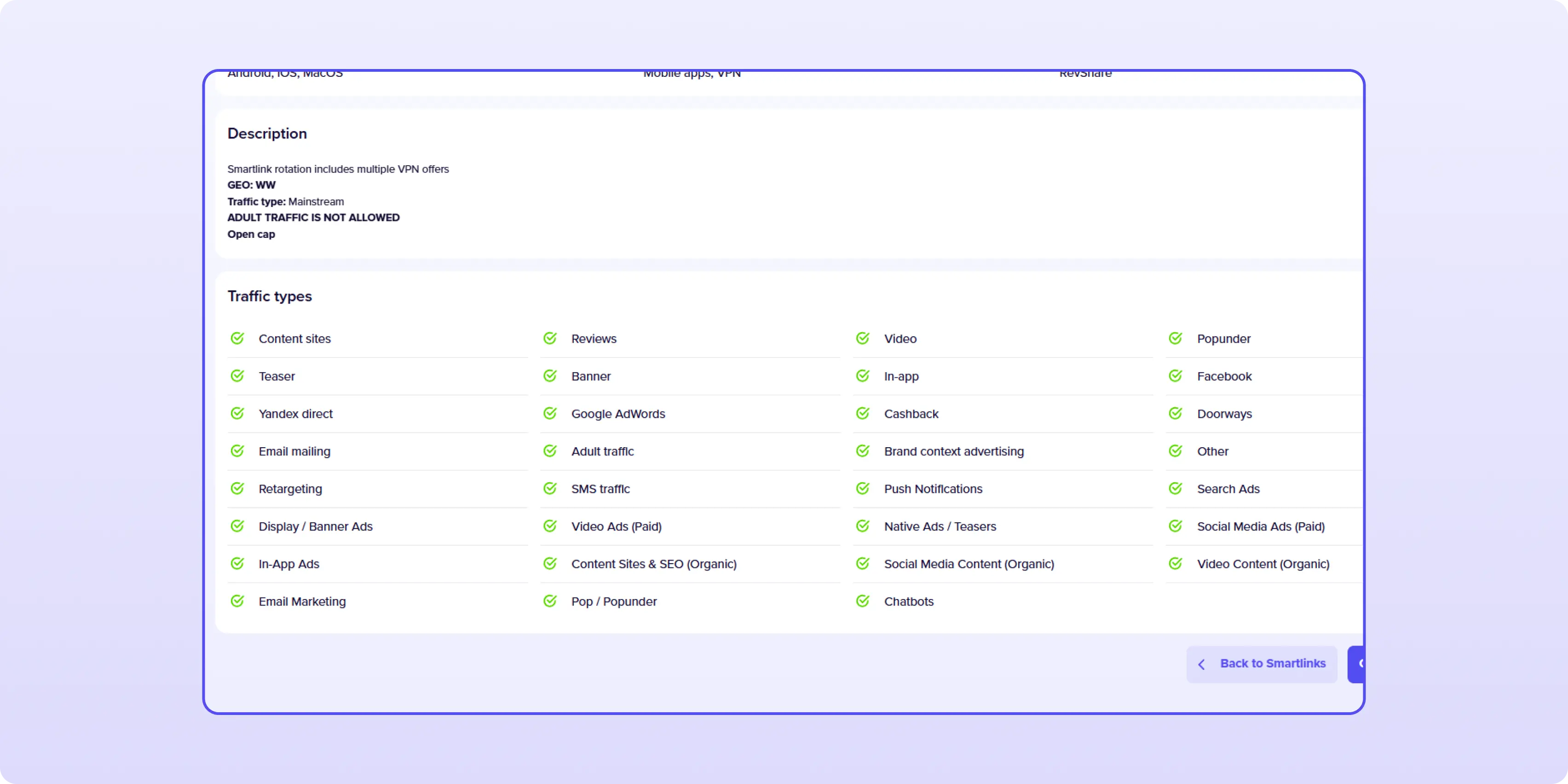
Supported Traffic Types
One of the key advantages of CIPIAI smartlinks is flexibility.
They are not tied to a single traffic source or funnel structure — which means you can route different types of traffic through the same link and still maintain efficient monetization.
For example, SEO traffic from content sites tends to have higher intent and works well with offers that require engagement or longer user interaction. The smartlink adapts by prioritizing flows that maximize long-term value.
At the same time, push notifications and popunder traffic operate on volume. Users have lower intent, so the system shifts toward simpler, faster-converting offers — often mobile-first flows that can capture quick conversions.
With social media traffic, behavior becomes less predictable. Some users are curious, others are ready to act. Smartlinks help absorb this variability by dynamically testing and routing traffic instead of forcing a single funnel.
For affiliates running search ads, where traffic is more targeted but cost-sensitive, smartlinks help balance conversion rate and payout — optimizing for EPC rather than just raw conversions.
In the case of in-app traffic, where users are already within a mobile environment, smartlinks prioritize lightweight flows that match user context and device behavior.
Even email marketing can benefit from this setup. Instead of segmenting lists manually for different offers, affiliates can use one smartlink and let the system adjust routing based on user response and GEO.
👉 The key point:
CIPIAI smartlinks are not optimized for a specific traffic source — they are designed to adapt to different traffic types automatically, which is exactly what makes them effective for scaling mixed and global traffic streams.
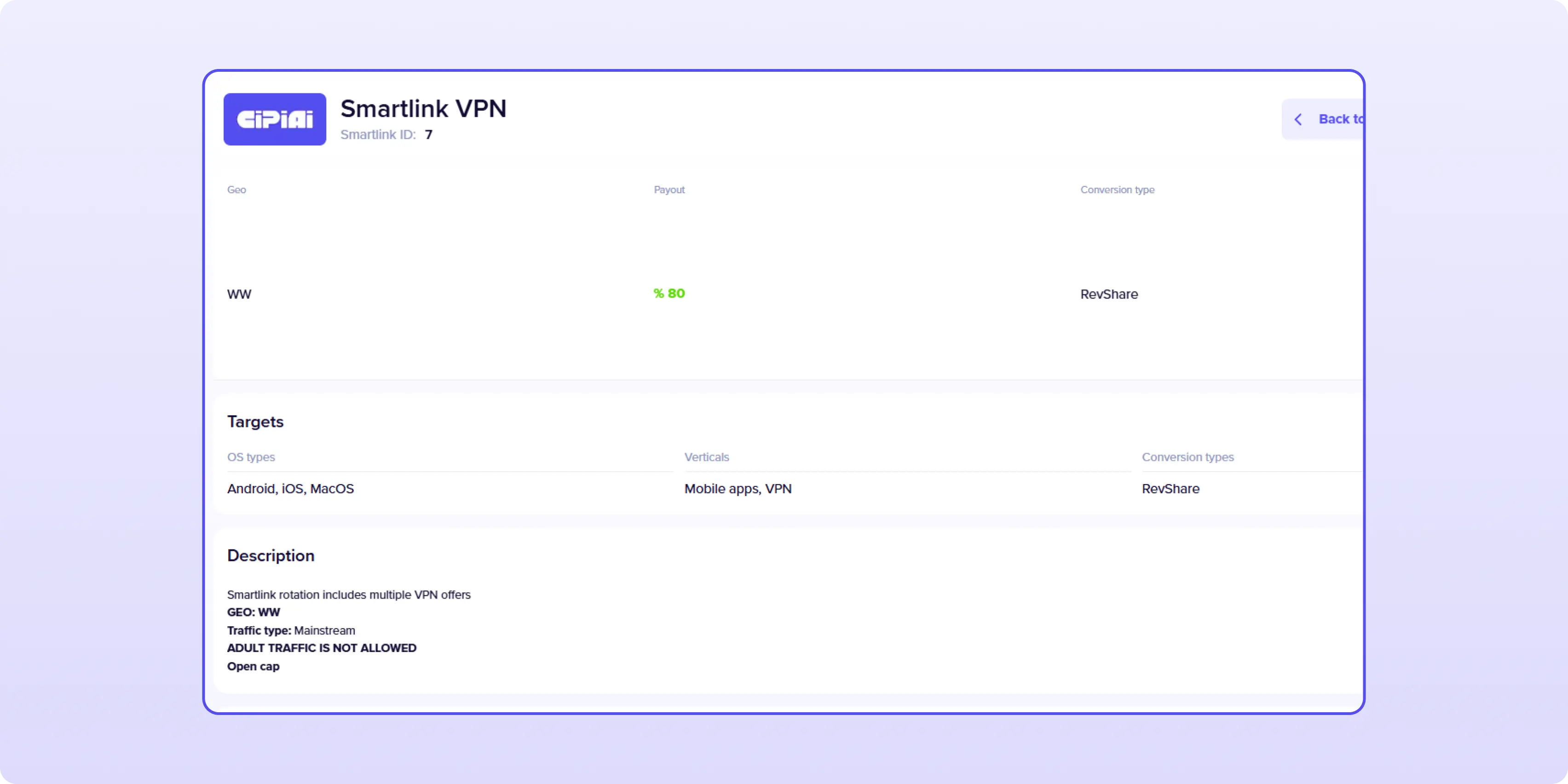
CIPIAI VPN Smartlink
Another practical implementation of smartlink affiliate marketing within CIPIAI is the VPN smartlink vertical.
This setup focuses on privacy-driven offers, which have consistent demand across multiple GEOs and traffic sources.
Core parameters:
Vertical: VPN
GEO: Global
Revenue model: RevShare up to 80%
How It Works
The VPN smartlink operates similarly to the mainstream flow, but with a more focused vertical.
When a user clicks:
the system identifies GEO and device
selects the most relevant VPN offer
redirects to a localized or optimized funnel
Because VPN demand is often tied to:
geo-restrictions
privacy concerns
content access
👉 routing plays a critical role in maximizing conversions.
Where It Performs Best
This type of smartlink is particularly effective for:
SEO traffic
(content around privacy, streaming, security, restrictions)
privacy-focused niches
(VPN reviews, comparisons, bypass guides)
geo-targeted traffic
(users trying to access region-locked content)
Why It Works
VPN offers naturally align with:
global traffic
mobile + desktop usage
recurring monetization models
Combined with smartlink routing, this allows affiliates to:
match users with the most relevant provider
optimize for GEO-specific demand
increase long-term revenue through RevShare
Note
Additional offers and smartlink configurations are available through your affiliate manager.
👉 This allows affiliates to:
expand beyond a single vertical
access GEO-specific setups
adjust monetization strategy as traffic evolves
Why Smartlinks Outperform Single Offers
At a basic level, both smartlinks and direct offers do the same thing — they convert traffic into revenue.
The difference is how efficiently they do it.
Higher EPC (Earnings Per Click)
With direct offers, your revenue depends on one decision:
👉 Did you choose the right offer?
If the answer is no:
traffic doesn’t convert
GEO mismatch kills performance
EPC drops immediately
Smartlinks remove this dependency.
Instead of relying on a single offer, they:
test multiple offers simultaneously
shift traffic toward better-performing options
optimize based on real conversion data
👉 The result is typically higher EPC across mixed traffic.
Not because any single offer is better — but because the system continuously adjusts.
Built-In Automation
Direct offers require constant manual work:
testing new offers
switching campaigns
adjusting GEO targeting
rebuilding funnels
This works at small scale, but becomes a bottleneck as traffic grows.
Smartlinks automate this layer.
They:
rotate offers automatically
adapt to traffic conditions in real time
reduce the need for manual intervention
👉 Instead of managing campaigns, you manage traffic flow and performance metrics.
Better Scaling
Scaling direct offers is linear.
one offer → one GEO → one funnel
expansion requires rebuilding everything
This creates friction:
more setups
more tracking
more maintenance
Smartlinks scale differently.
Because they:
support multiple GEOs
handle multiple verticals
adapt to different traffic types
👉 you can scale volume first, and let the system optimize distribution.
The Core Difference
Direct offers:
require precision upfront
depend on correct assumptions
break when traffic changes
Smartlinks:
adapt dynamically
absorb traffic variability
improve over time with data
Simple Comparison Logic
👉 If you know exactly:
your GEO
your audience
your converting offer
→ direct offers can work well
👉 If you have:
mixed or global traffic
multiple sources
unpredictable user behavior
→ smartlinks almost always outperform
Key Takeaway
Smartlinks do not replace direct offers — they replace the need to guess which offer will work.
By combining:
EPC-driven optimization
automated rotation
scalable structure
they turn traffic monetization into a system — not a series of manual decisions.
Smartlink vs Direct Offers
Choosing between smartlinks and direct offers is not about “which is better” — it’s about how much control vs automation you need.
Direct offers give you precision.
Smartlinks give you adaptability.
Smartlink
Direct Offer
Rotation / Logic
Automated offer rotation based on GEO, device, and performance
Manual selection of a single offer
Optimization
Optimized for EPC across mixed traffic
Performance depends on one chosen offer
Scalability
Scales easily across multiple GEOs and traffic sources
Requires separate setups for each GEO and campaign
Management Effort
Low manual effort after setup
Requires постоянного тестирования и оптимизации
Control
Less control over exact offer shown
Full control over funnel, creatives, and offer
Best For
Best for unknown or mixed audiences
Best for highly targeted traffic
How to Think About It
👉 Smartlinks = system-based optimization
👉 Direct offers = manual optimization
With direct offers, you:
pick the offer
build the funnel
optimize step by step
With smartlinks, you:
send traffic
track EPC
scale what works
When Each Approach Works Best
Use smartlinks if:
traffic is global or mixed
you don’t know the best offer заранее
you want to scale quickly without rebuilding funnels
Use direct offers if:
you have high-intent traffic
you understand your audience deeply
you want full control over every step of the funnel
Key Takeaway
Smartlinks reduce decision complexity.
Direct offers increase control.
👉 The more uncertain your traffic is, the more valuable smartlinks become.
Best Traffic Sources for Smartlinks
Smartlinks are designed for one specific scenario:
👉 when traffic is diverse, unpredictable, or global
Unlike direct offers, they don’t require perfect targeting upfront. Instead, they adapt to different traffic types and optimize monetization dynamically.
That said, some traffic sources naturally work better with smartlinks than others.
SEO Traffic
SEO traffic is one of the most stable and scalable sources for smartlinks.
Users coming from search:
often have mixed intent
come from different GEOs
use different devices
👉 This creates variability — which is exactly where smartlinks perform well.
Instead of building separate pages or funnels for each segment, you can:
send traffic through a single smartlink
let the system match users with relevant offers
Best use cases:
content sites
review articles
comparison pages
informational queries
👉 Especially strong for:
VPN
utilities
mobile apps
Paid Traffic
Paid traffic introduces a different dynamic — cost sensitivity.
You need:
predictable performance
fast optimization cycles
clear ROI signals
Smartlinks help by:
automatically testing multiple offers
shifting traffic toward higher EPC options
reducing the need for constant manual campaign changes
However:
👉 they work best when:
you don’t know the winning offer yet
you are testing new GEOs or verticals
For highly optimized campaigns, some affiliates still switch to direct offers after validation.
Push / Pop Traffic
Push and pop traffic are where smartlinks often perform best.
This traffic is:
high volume
low intent
highly variable
Sending it to a single offer usually results in:
low CR
wasted clicks
Smartlinks solve this by:
routing users to simpler, faster-converting flows
adapting to GEO and device instantly
👉 Typical verticals:
PIN submit
surveys
mobile subscriptions
Social Traffic
Social traffic sits in between — it’s unpredictable but scalable.
Users from:
Facebook
TikTok
other platforms
can have:
different levels of intent
different expectations
different behavior patterns
Smartlinks help absorb this variability.
Instead of forcing one funnel, they:
test multiple offers in parallel
adjust based on real performance
improve monetization over time
Key Takeaway
Smartlinks are not tied to a specific traffic source.
They are most effective when:
traffic is mixed
intent is inconsistent
manual optimization becomes inefficient
👉 The more variability in your traffic,
the more value smartlinks provide.
When You Should Use Smartlinks
Smartlinks are not always necessary — but in certain scenarios, they significantly outperform direct offers.
The key trigger is uncertainty.
👉 The less you know about your traffic, the more valuable smartlinks become.
Global Traffic
If your traffic comes from multiple GEOs, smartlinks become almost essential.
Different regions:
respond to different offers
have different payout levels
require different flows
Trying to manage this manually means:
creating multiple campaigns
splitting traffic by GEO
constantly adjusting funnels
Smartlinks handle this automatically.
👉 They detect user location and route traffic to the most suitable offer without additional setup.
Unknown or Mixed Audience
When you don’t fully understand your audience, direct offers become a risk.
You might not know:
what users expect
what converts best
which vertical fits their intent
Smartlinks reduce this uncertainty.
Instead of guessing, you:
send traffic into a system
let it test multiple offers
identify what works through performance data
👉 This is especially useful for:
new traffic sources
experimental campaigns
mixed content traffic
Testing New Traffic or GEOs
Smartlinks are one of the fastest ways to test.
Instead of:
selecting one offer
building a full funnel
risking budget on assumptions
You can:
launch with a smartlink
analyze EPC and conversion patterns
identify winning segments
👉 Once you have data, you can:
keep scaling smartlinks
or transition to direct offers for more control
Key Takeaway
Use smartlinks when:
traffic is global
audience behavior is unclear
you are in the testing or scaling phase
They are not just a shortcut — they are a way to reduce uncertainty and accelerate optimization.
And in affiliate marketing, that often translates directly into better results.
How to Start with Smartlinks
Getting started with smartlink affiliate marketing is straightforward — the complexity is handled by the system, not the affiliate.
The goal is simple:
👉 send traffic → measure performance → scale what works
Step 1 — Choose a Smartlink
Start by selecting a smartlink that matches your traffic type and vertical.
For example:
mainstream smartlinks → mixed traffic
VPN smartlinks → SEO / privacy niches
mobile-focused smartlinks → push / in-app traffic
👉 If you’re unsure, start broad — smartlinks are designed to adapt.
Step 2 — Send Traffic
Once you have your smartlink, plug it into your traffic source:
content pages
ads
push campaigns
social platforms
At this stage, avoid over-segmentation.
👉 The system needs data to optimize — volume matters.
Step 3 — Track EPC
The main metric for smartlinks is:
👉 EPC (earnings per click)
This tells you:
how well your traffic is monetized
whether the routing logic is working
which sources perform best
Unlike direct offers, you’re not optimizing for a single conversion — you’re optimizing overall revenue efficiency.
Step 4 — Optimize and Scale
Once data starts coming in, optimization becomes straightforward:
identify top-performing traffic sources
increase volume where EPC is highest
remove underperforming segments
👉 At scale, this becomes a simple loop:
traffic → data → scaling
Common Mistakes
Smartlinks simplify monetization — but they don’t fix плохой трафик или ошибки в подходе.
Here are the most common issues:
Wrong GEO
Sending traffic from unsupported or low-performing GEOs can reduce EPC.
👉 Even though smartlinks adapt, not all regions monetize equally.
Poor Traffic Quality
Low-quality or untargeted traffic leads to:
low engagement
weak conversions
unstable EPC
👉 Smartlinks optimize distribution — not traffic quality.
No Tracking
Running smartlinks without proper tracking is a major mistake.
Without data, you can’t:
identify profitable sources
scale effectively
understand performance
👉 Always track:
clicks
EPC
traffic segments
Conclusion
Smartlink affiliate marketing has evolved into a core tool for modern affiliates.
In a landscape defined by:
fragmented traffic
global audiences
multiple verticals
👉 manual optimization becomes a limitation.
Smartlinks solve this by introducing:
automated offer selection
EPC-driven routing
scalable monetization logic
FAQ
What is a smartlink in affiliate marketing?
A smartlink is an automated affiliate link that redirects users to the most relevant offer based on GEO, device, and performance data.
How do smartlinks work?
Smartlinks analyze incoming traffic in real time and route users to the best-performing offer using auto-rotation logic and EPC optimization.
Are smartlinks profitable?
Yes — especially for mixed or global traffic.
They typically increase EPC by:
distributing traffic across multiple offers
optimizing based on performance data
What traffic works best for smartlinks?
Smartlinks work best with:
SEO traffic
push and pop traffic
social and in-app traffic
👉 especially when traffic is diverse or unpredictable.
Smartlink vs direct offer — which is better?
It depends on your setup.
smartlinks → better for scaling and mixed traffic
direct offers → better for highly targeted campaigns
👉 smartlinks reduce guesswork, while direct offers give more control.




.webp)