Affiliate Pulse: AI Tools, Meta Ads Scaling & Buyer-Intent Traffic
AI tools, Meta Ads scaling strategies, buyer-intent traffic and new affiliate marketing tactics. This week’s Affiliate Pulse breaks down the most important industry signals.



If you step back and look at this week's signals as a whole, the pattern becomes clearer than before. Affiliate marketing is not getting harder in the way most people expect. Tools are improving, content production is accelerating, and traffic is easier to generate than it was even a year ago.
And yet, outcomes are not improving at the same rate.
The real constraint is shifting. It's no longer about access - it's about control. Control over intent, over tracking, over economics. And this is exactly where most systems start to break.
Pinterest continues to be framed as an “easy entry” channel: find trending products, create pins, attach affiliate links, and post consistently. On the surface, the logic is solid. Intent-driven discovery, visual content, passive distribution.
But when you look at what’s actually missing from this model, the same gap appears every time: there is no mechanism for connecting interest to purchase intent. Pinterest can generate clicks. Whether those clicks convert depends entirely on what happens between the pin and the landing page - and that part is rarely addressed.
The content treats traffic as the output. In practice, traffic is just the input.
Coupon and deal-based affiliate strategies are seeing renewed attention. The model is straightforward: target users searching for discount codes, capture them at high purchase intent, monetize the click. Under the right conditions, this delivers strong conversion rates.
The structural problem is dependency. Revenue is tied to specific deals, merchant relationships, and promotional windows. Any of these can change without notice. What looks like a stable income source is actually a brittle one - dependent on factors outside the affiliate’s control.
High intent does not equal sustainable monetization if the underlying offer changes.
AI use cases in affiliate marketing continue to proliferate: content creation, research, automation, ad generation. The appeal is real. Efficiency gains are measurable. Production speed increases significantly.
The problem is not the tools. It’s the assumption behind them - that more output leads to more revenue. This holds only when the underlying system is already working. If the funnel has gaps in targeting, intent matching, or economics, AI amplifies those gaps rather than fixing them.
Speed without direction is not leverage. It’s just faster failure.
Done-for-you affiliate systems represent a growing market segment. Funnel builders, landing page systems, email sequences, coaching programs - all promising a ready-to-run infrastructure.
The core issue is ownership. When the system is provided rather than built, the operator doesn’t fully understand its dependencies. When something breaks - a tracking pixel, an offer update, a domain issue - they can’t diagnose or fix it independently.
Convenience has a structural cost: it shifts control from the operator to the provider.
SEO-based affiliate strategies continue to circulate, particularly those built around third-party platforms: Medium articles, PDF distribution, YouTube SEO. The model relies on borrowing distribution from established domains rather than building owned assets.
This is efficient in the short term. But it creates a different type of dependency: the affiliate’s traffic is contingent on another platform’s rules, algorithm, and policies. A content policy update or domain authority shift can remove the traffic source entirely.
Borrowed infrastructure is not a foundation. It’s a temporary leverage point.
Affiliate marketing continues to expand into new markets, particularly mobile-first regions. The opportunity is real, driven by growing e-commerce adoption and accessible payment systems.
At the same time, early-stage patterns repeat. New entrants tend to focus on accessibility and speed - how to start, how to earn quickly, how to replicate visible success. The structural complexity of affiliate systems often becomes visible only later, when initial expectations don't align with results.
Growth does not remove complexity. It redistributes where it appears in the lifecycle.
Also read

Discussions on Reddit provide a more direct view of where systems fail in practice. A recurring theme is the disconnect between visibility and revenue - users report gaining views and engagement, but not seeing corresponding conversions.
This reinforces a core point: attention alone is not monetization.
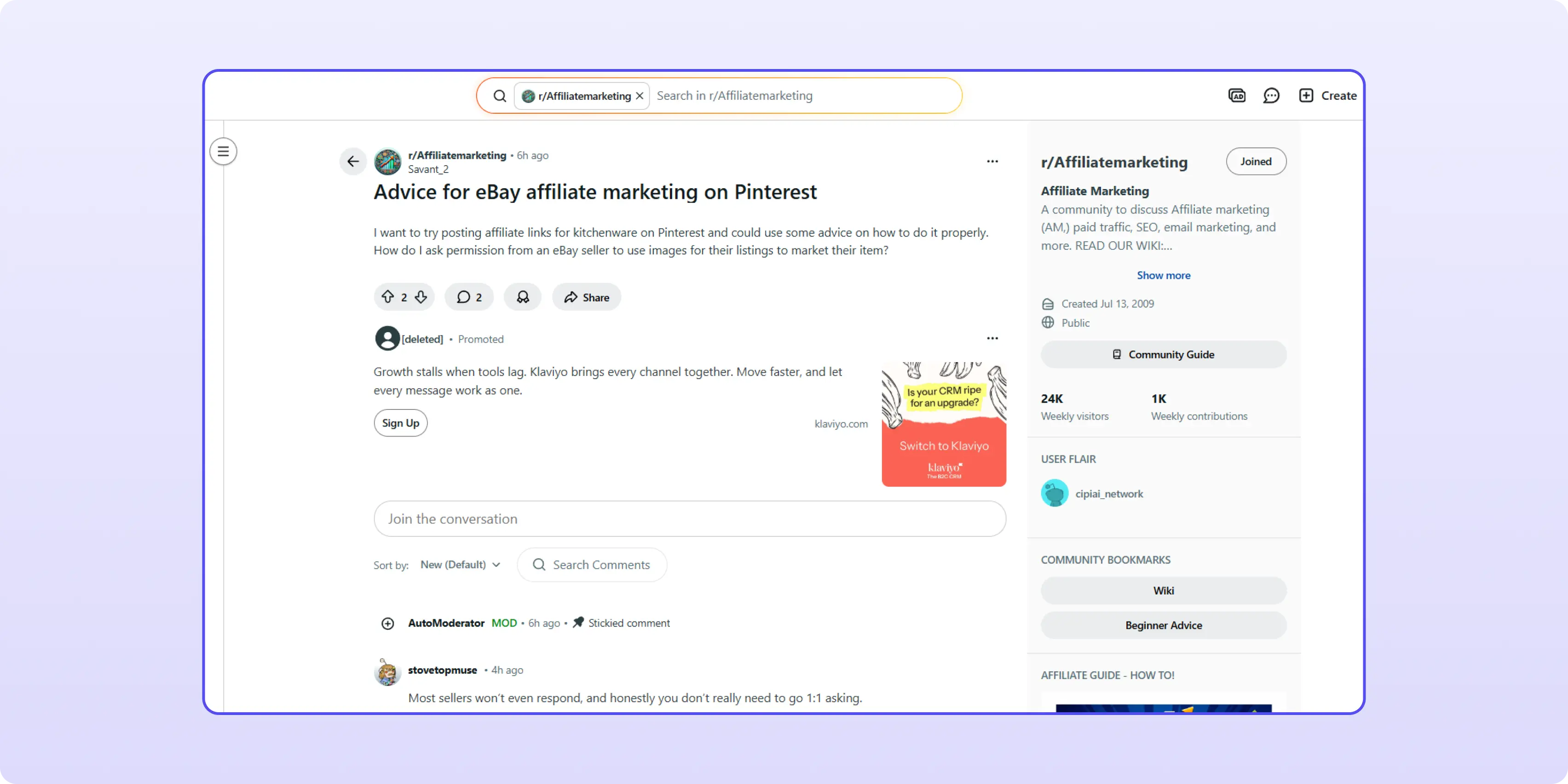
There are also more operational questions - around content usage, platform rules, and technical setup - which indicate that even foundational elements are not fully understood by many participants.
The barrier is no longer access to tools or traffic. It is the ability to structure them correctly.
There is increasing focus on how platforms like Meta operate - not just as distribution channels, but as systems built around behavioral prediction. This shifts the conversation from reach to control over outcomes.

At the same time, practitioners highlight more practical issues: tracking failures that go unnoticed, leading to incorrect decisions and lost revenue; the ongoing operational complexity of affiliate work, including bans, offer changes, and unstable attribution.


Even discussions around AI and new technologies like blockchain-based affiliate systems follow a similar pattern. They promise efficiency or transparency, but raise questions about whether they simplify the system - or add new layers of complexity.


Across all of this, one idea becomes more consistent. Performance is not limited by tools. It is limited by how well those tools are controlled and integrated.
Affiliate marketing is not moving toward simplicity.
It is moving toward structure.
The surface layer - content, traffic, platforms - is becoming easier to access. But the underlying system is becoming more demanding. It requires alignment between traffic, intent, funnel logic, and economics.
Without that alignment, results remain inconsistent, regardless of scale.
There are more opportunities than ever, but also more noise. The difference between the two is not always obvious.
The people who achieve consistent results are not necessarily using different tools. They are building systems they understand, controlling the variables they depend on, and scaling only what has already proven stable.
CIPIAI is built around that principle.
Not maximizing access or speed, but reducing uncertainty through structure. Controlled traffic, transparent rules, and systems designed to remain stable as volume grows.
Ready to test CPA offers with full structural support? Register on CIPIAI or browse available offers.


Bisdev Solutions Limited
Room 701, 7/F, Lucky Centre, 165-171
Wanchai Road, Wan Chai, Hong Kong China
Copyright © 2026. Bisdev Solutions Limited
All rights reserved