Affiliate Pulse #5: Affiliate Marketing Is Getting Easier to Start - Harder to Scale
AI tools, high-ticket hype, and real operator strategies - the gap in affiliate marketing is getting wider.


Affiliate marketing this week had a recurring theme hiding in plain sight: control.
Who controls attribution. Who controls audience growth. Who controls the impulse to touch a campaign that's working. The signals from Reddit, X, and the community converge around one uncomfortable truth - most affiliates are losing money not because their traffic is bad, but because they keep intervening when they shouldn't.
Let's break it down.
This week on r/AffiliateMarketing, someone asked a very specific question:
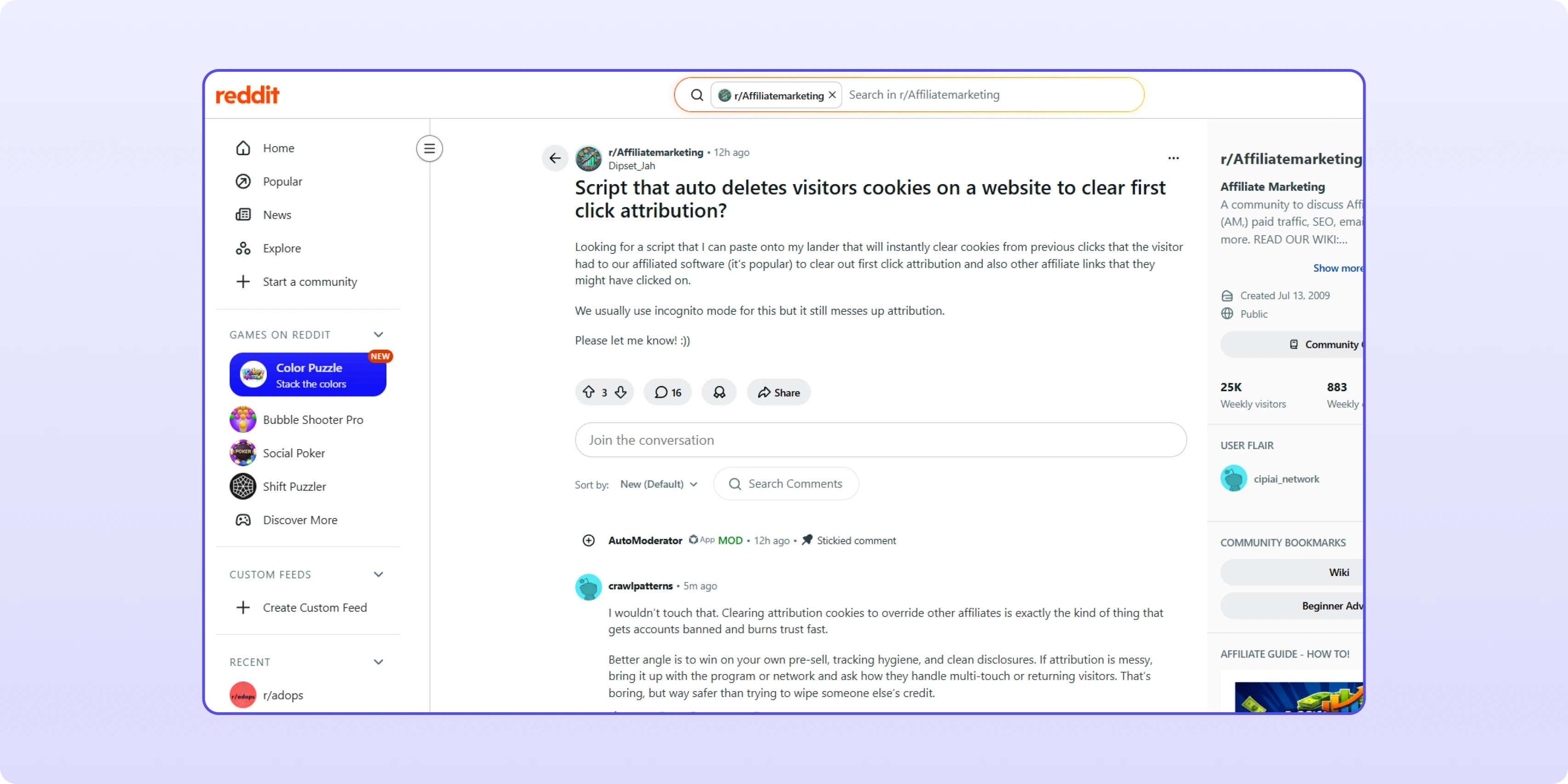
On the surface, it's a technical question. But read it again.
Someone is actively trying to manipulate attribution data - not to deceive the end advertiser, but to manage how credit gets assigned internally or across networks. This is a symptom of a much bigger problem: affiliate attribution is still fundamentally broken, and people are improvising hacks to work around it.
First-click vs. last-click attribution has been a battleground for years. But as multi-touch funnels become more common - TikTok awareness → Google search → landing page → conversion - the question of who gets credit becomes a genuine operational headache.
The cookie-deletion approach is clever in its own way, but it's also fragile. Browser privacy updates (iOS, Chrome's Privacy Sandbox trajectory) are already destroying cookie-based tracking. Building a workaround on top of a dying system is building on sand.
When affiliates start manually hacking attribution, it means the platforms haven't given them a better answer. Networks that offer transparent, granular attribution data - or that switch to fingerprint/server-side tracking - have a real competitive advantage right now.
If you're running multi-source traffic, this is the moment to audit your attribution setup. Not next quarter. Now.
Also read
The most-liked post this week came from a creator who shared something remarkable:
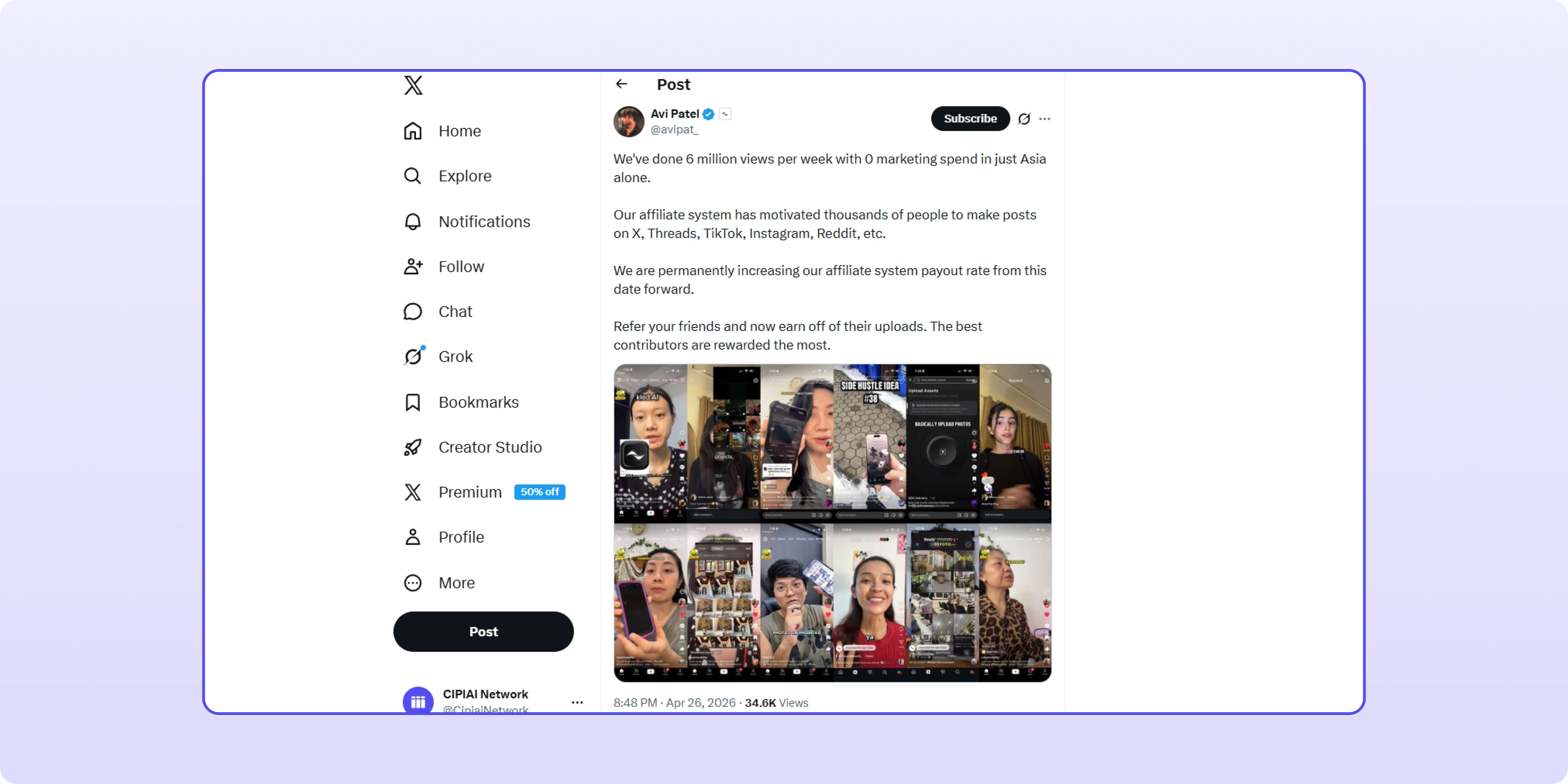
"We've done 6 million views per week with 0 marketing spend in just Asia alone. Our affiliate system has motivated thousands of people to make posts on X, Threads, TikTok, Instagram, Reddit, etc. We are permanently increasing our affiliate system payout rate."
The mechanism? An affiliate system that motivated thousands of people to post across every major platform - essentially turning every user into a distribution channel. And now they're doubling down by permanently raising payout rates to accelerate the flywheel. This is not a new idea. Referral programs have existed since the internet began. But the scale and deliberateness here is worth studying. The creator didn't run ads. They built incentive architecture - and let other people's content do the work.
What affiliates can learn from this: The best affiliate systems don't just pay commissions. They create content loops. If you're only thinking about your own posts and campaigns, you're leaving the most scalable distribution channel untouched.
The second most-discussed post this week was a confession:
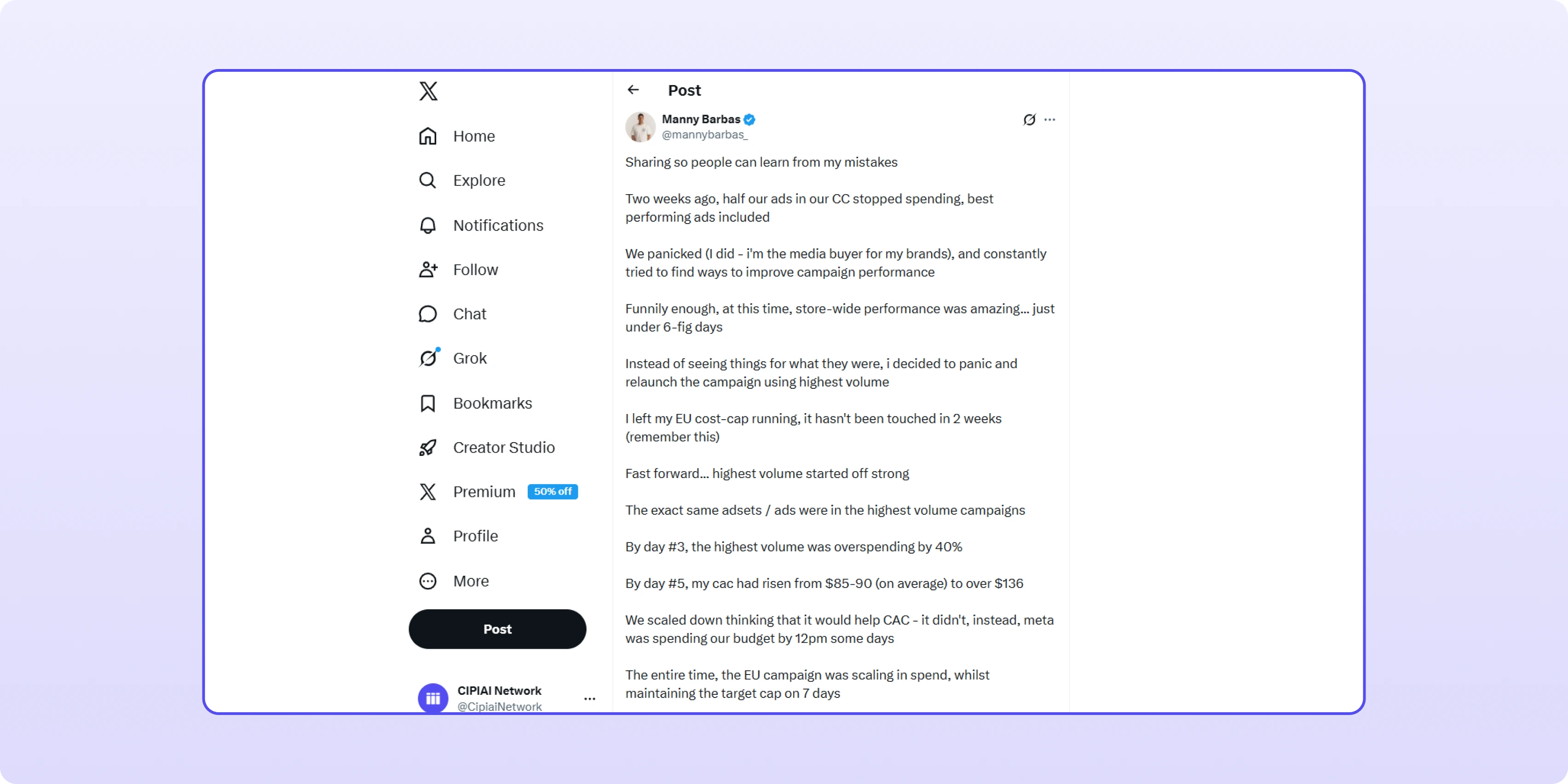
"I panicked when my ads stopped spending, relaunched campaigns, and ruined performance. When I left the cost-cap campaign untouched, performance normalized. Sometimes the best thing in marketing is to do nothing."
This sounds almost absurd in an industry that rewards hustle. But it reflects something that experienced media buyers know and beginners almost always learn the hard way: campaign algorithms need time to find their footing, and premature intervention resets the learning phase.
The broader implication: Most affiliate marketers have a bias toward action. Dashboards are designed to make you feel like you should be doing something. But touching a campaign that's in a temporary dip is one of the most expensive mistakes in paid traffic. Building the discipline to wait - and knowing when patience ends and a real problem begins - is a skill that separates junior from senior buyers.
A short post that landed harder than expected:
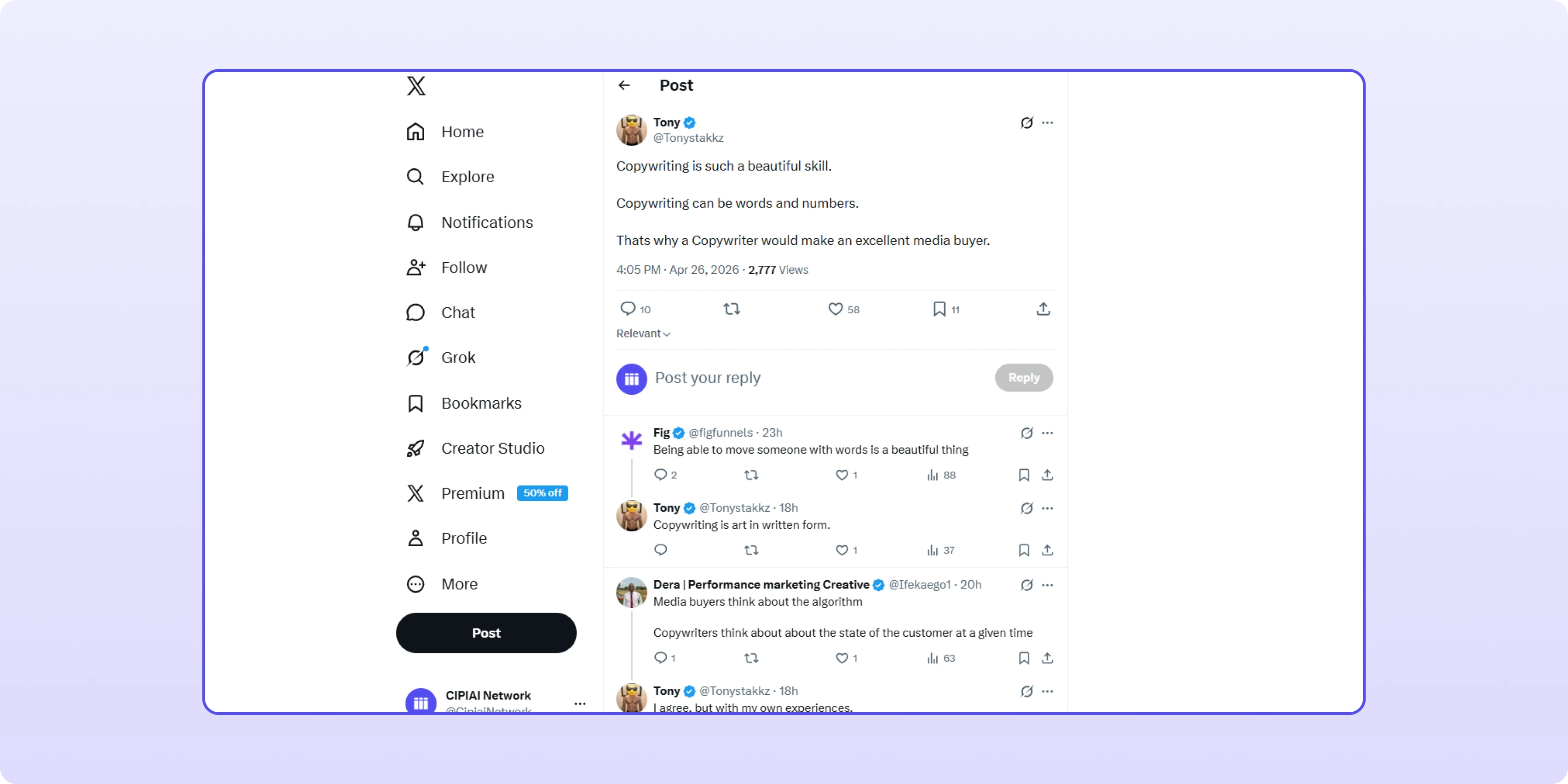
The core insight holds. Media buying at its core is about understanding human attention and decision-making - which is exactly what copywriting trains you for. The data layer (CPM, CTR, CVR) comes with practice. The intuition for what makes someone click? That's harder to teach, and copywriters often already have it.
Practical takeaway: If you're a media buyer who's never studied copy, it's time to fix that. If you're a copywriter who thinks paid traffic is too technical - it isn't. The models are learnable. Your instincts might give you a real edge.
One more post worth noting this week:
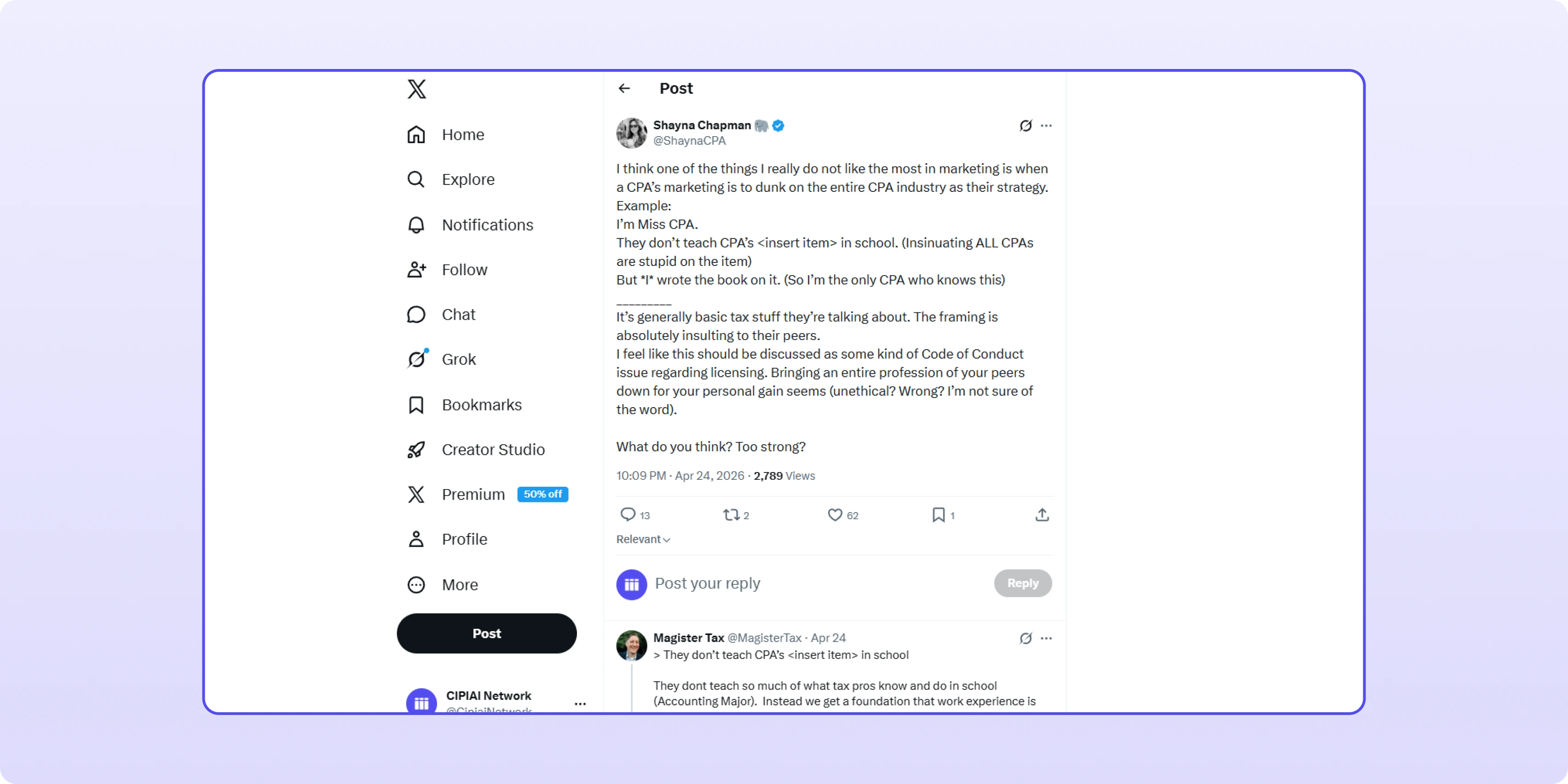
"I think one of the things I really do not like the most in marketing is when a CPA's marketing is to dunk on the entire CPA industry as their strategy. Bringing an entire profession down for personal gain seems unethical."
Short, direct, and accurate. The CPA space has a visibility problem - a lot of the loudest voices built their audience by attacking the industry they operate in. As the space matures, this approach is increasingly being called out. Worth keeping in mind if you're building a personal brand in this niche.
AI isn't a differentiator anymore - it's expected infrastructure. The conversation has moved from "should I use AI?" to "which parts of my workflow should AI own?" Media buyers are using agents for campaign auditing. Content creators are using AI for full funnel production. The affiliates still building everything manually are quietly falling behind.
There's detailed tactical discussion around TikTok's GMV Max amplification model and how it rewards specific creative patterns: 18-second videos, strong hooks in the first 2 seconds, a product demo, and a clear CTA. This isn't just theory - creators who've cracked this format are reporting outsized reach for the same budget.
The formula is deceptively simple. The execution is where most people fail. Hook → proof → ask. In 18 seconds. That's the game.
Several creators this week emphasized CPA and hybrid revenue models as the most reliable path to consistent affiliate income. Not the most glamorous take, but probably the most honest one. CPA works when you pick the right offer, understand the traffic-to-conversion funnel, and resist the temptation to jump to a new offer every time results plateau.
Projects like AdaLink and Uni-Fy are building decentralized affiliate infrastructure - tokenized rewards, on-chain performance tracking, transparent attribution. It's still early. But the problems they're solving (trust, transparency, payout reliability) are real problems that traditional networks haven't fully cracked. Worth watching.
Conversational, gossip-style ad copy that mimics real messaging is outperforming polished ad creative for older audiences. The insight: audiences over 45 have developed strong ad blindness to anything that looks like an ad. But they still engage with things that look like a conversation or a recommendation from a friend.
If you're running campaigns targeting this demographic and you're using standard display-style creatives, there's likely performance sitting on the table.
This week's signals cluster around a single underlying tension: the gap between what affiliate marketing looks like and how it actually works.
It looks like viral growth, easy systems, and automated income. It works through attribution infrastructure, campaign discipline, audience incentives, and creative precision.
The cookie manipulation question on Reddit, the "do nothing" lesson on X, the viral affiliate system built on payout structure - they're all pointing at the same thing. The affiliates who win aren't the ones moving fastest. They're the ones who've built systems that work when they step back.
That's a different skill set than most people are developing.
Want to put these insights to work? Join CIPIAI and get access to offers across all verticals covered in this digest.
Affiliate Pulse is a weekly digest of what's actually moving in affiliate marketing - signals from Reddit, X, and the broader community, with analysis on what it means for operators and marketers.


Bisdev Solutions Limited
Room 701, 7/F, Lucky Centre, 165-171
Wanchai Road, Wan Chai, Hong Kong China
Copyright © 2026. Bisdev Solutions Limited
All rights reserved