A CPA network and a payment service protect two different parts ofmedia buying profit: the network determines offer stability, leadapproval, and payout speed, while the payment service determineswhether ad spend survives card blocks, deposit delays, and conversionfees. Scaling stalls when either one fails, regardless of creativequality. Media buyers who pair a network with fixed hold periods andfast payouts with a payment service built for ad spend — instantcard issuance, resistance to blocks, crypto funding — cut the gapbetween registration and first traffic from days to hours.
Every media buyerknows the formula: take an offer, launch traffic, make a profit.Between "launching" and "getting paid," though,sits a chain most people only think about when it breaks — the CPAnetwork the offer runs through, and the payment service the ad spendruns through. Here’s who’s responsible for what in that chain,and why the weakest link can sink a good campaign.
What Does Profit From a Media Buying Campaign Actually Consist Of?
Profit is not simply the difference between advertising spend and the payout for an offer. It is the result of several participants working together, with each one responsible for a specific area.
Offer selection - the affiliate network is responsible; risks: low CR, unstable payouts, and a long hold period.
Traffic launch - the media buyer/team is responsible; risks: weak creatives and the wrong traffic source.
Advertising payments - the payment service is responsible; risks: card blocks, deposit delays, and hidden fees.
Receiving payouts - the affiliate network/payment provider is responsible; risks: lengthy withdrawals and losses caused by currency conversion.
Scaling - all links in the chain are responsible; risks: any failure in the chain can stop growth.
If even one link starts to fail, the entire ROI calculation goes out the window - even with the perfect combination of creative, GEO, and offer.
Why Does the CPA Network Determine Whether an Offer Stays Profitable?
A good affiliate network gives a webmaster more than just a list of offers. It provides infrastructure for stable earnings: transparent analytics, predictable payouts, and support during the scaling stage - not only at the beginning. For example, at CIPIAI, this is built around a performance-focused approach: direct advertisers, proprietary offers, and a manager who helps not simply choose an offer, but build a workable scaling strategy.
What really matters to a media buyer when choosing a network:
Transparent real-time statistics on CR and lead approval rates.
Direct offers without unnecessary intermediaries - resulting in higher and more stable payouts.
Fixed hold periods, without “rubber-stretching” the waiting time for lead confirmation.
Support for GEOs and verticals, rather than generic advice.
Fast withdrawal of earned funds - otherwise, the money remains “stuck” instead of being reinvested into a new budget.
What Should You Check Before Choosing a Virtual Card for FacebookAds?
While a media buyer is watching CTR and CR, real losses often happenat the stage nobody is monitoring: paying for the ads. A card blockedmid-test, a deposit delayed a day, a currency conversion fee nobodyaccounted for — each eats budget and time faster than a creativethat just didn’t perform. A payment service deserves the samescrutiny as an offer: not a clean landing page, but proven stabilityunder load.
Technical Selection Criteria
Card issuance speed - it is important to receive a working tool within minutes, rather than waiting a day while the test is being prepared.
Resistance to blocks on Facebook Ads, Google Ads, and TikTok Ads.
Crypto deposits - faster and without banking delays.
API integration for mass card issuance if you work as a team or agency.
Financial Conditions
Transparent fees without surprises during withdrawals or currency conversion.
Spending limits - it is important that the platform does not restrict the purchase volume at the peak of a test.
Multicurrency accounts - it is convenient to manage turnover in several currencies at once without losing money on conversion.
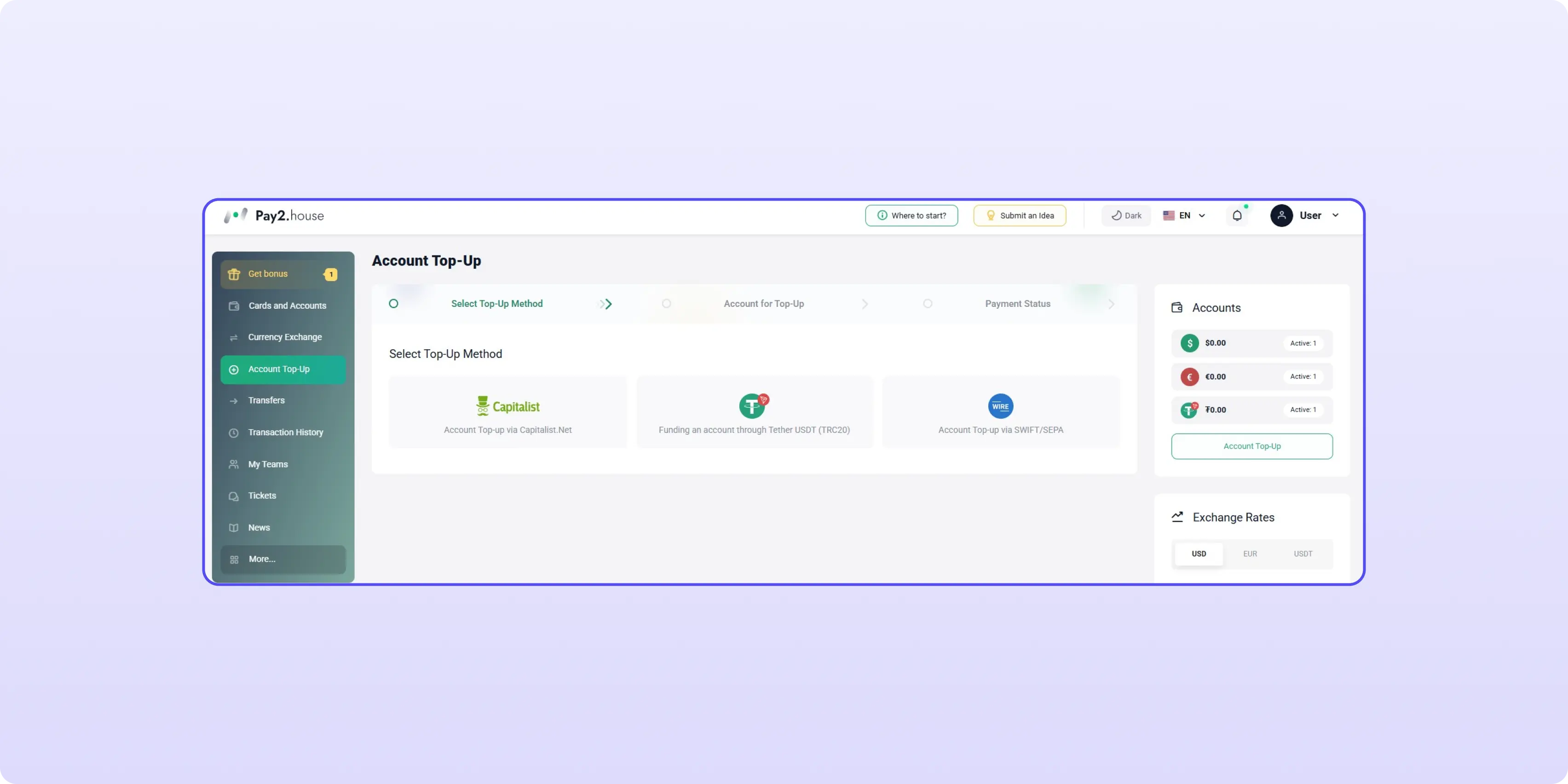
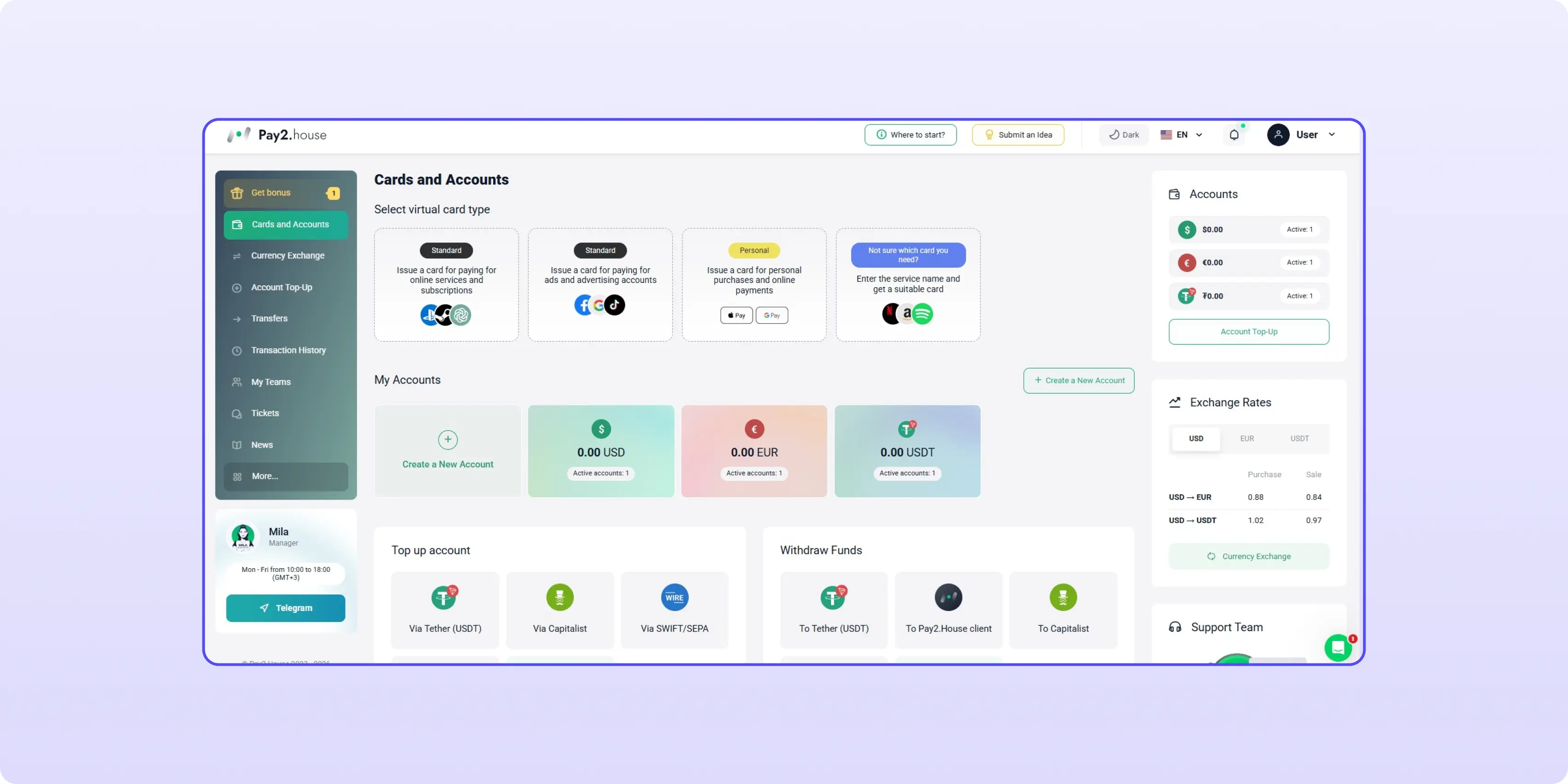
Pay2.House is a good example here - a virtual card service originally designed for media buying: cards are issued instantly, work with minimal risk of being blocked, can be funded in USDT, and support API-based mass issuance.
How Much Does a CPA Network + Payment Service Setup Actually Changethe Numbers?
The differencebetween a random stack of tools and a properly built setup shows upin the final margin, not just launch speed.
Parameter
Without a setup
Well-built network + payment service setup
Time from registration to first traffic
1–3 days
Hours
Risk of losing budget due to a card block
High
Minimal
Speed of profit withdrawal
Days
Minutes–hours
Team scaling
Manual, with delays
Through API, without bottlenecks
Expense control by campaign
One general balance
A separate card for each campaign
The practice of agencies and media buying teams illustrates this point especially well: they issue a separate virtual card for each campaign in order to isolate budgets and maintain control when scaling across several GEOs at once.
What Extra Features Should a Payment Service for Media Buying Include?
The offer sets the earning ceiling, but the infrastructure - the network and the payment service - determines how much of that ceiling actually reaches your wallet. Before chasing the next “high-payout” offer, it is worth checking two simple things: does the network pay reliably, and will the payment service hold up under load?
In addition to basic stability, a high-quality payment service for media buying usually has several other features that often determine the final choice:
Multicurrency accounts in USD, EUR, and USDT - you can keep working capital in a convenient currency and switch between currencies without delays.
Operation without KYC - all functions are available without completing verification.
Instant currency exchange within the dashboard, without separate requests or waiting.
High spending limits - up to $100,000, covering even large team purchases.
Free internal transfers between users - convenient for distributing budgets among media buyers or teams.
Mass card issuance - allows you to separate budgets, work with multiple accounts, and scale quickly.
A referral program with a percentage of the deposits made by invited colleagues - additional income alongside your main media buying activity.
What Ultimately Determines Media Buying Profit?
The offer setsthe ceiling on what you can earn. The infrastructure — the networkand the payment service — determines how much of that ceilingactually reaches your wallet. Before chasing the next high-payoutoffer, check two things: does the network pay reliably, and will thepayment service hold up under load? The answer to both is thedifference between a test that runs at a loss and a setup that scaleswithout the constant risk of losing budget to something that hasnothing to do with the offer itself.
FAQ
What is a virtual card for Facebook Ads used for?
It lets a mediabuyer fund an ad account without the declines and holds that personalor generic business cards often trigger on Meta’s payment system.These cards are typically issued instantly, can be funded with cryptosuch as USDT, and can be issued per campaign to keep budgets andspend limits separate.
Why do payment cards get declined on Facebook Ads?
Ad platforms runrisk checks on billing that flag unfamiliar issuers, sudden spendspikes, or cards with no prior spending history on the platform. Acard built specifically for ad spend is designed to clear thesechecks more consistently than a standard bank card.
How fast should a CPA network pay out affiliate earnings?
A reliablenetwork sets one fixed hold period instead of extending it case bycase, and processes withdrawals in minutes to hours rather than days.Slow payouts delay reinvestment into the next test, which is a realscaling cost even on a profitable campaign.
Can affiliates fund virtual cards with USDT?
Yes. Severalpayment services built for media buying, Pay2.House among them,accept USDT deposits alongside standard currencies, which skips thedelay of a bank transfer when topping up an ad account.
Do media buying teams need a separate card for every campaign?
Teams scalingacross multiple GEOs commonly issue one card per campaign to isolatebudgets and see which campaign is actually profitable, instead oftracking spend against a single shared balance.